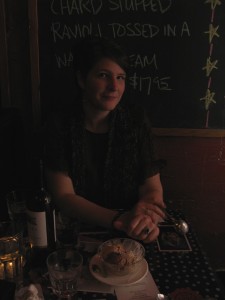
It is Veteran’s Day and I miss my friend Crysta Casey, who was a military journalist, poet, and painter. We met in 2002 at Red Sky Poetry Theatre (Seattle’s longest running open mic series). We were quite different people – she was 25 years my senior, a military veteran, and sufferer of extreme mental health issues – yet we had a very casual and organic friendship that came together quite effortlessly. It was only after her death, did I realize she was also my mentor and artistic advisor.
After the reading that night, Crysta and I talked on the street for a long time. She smoked cigarettes as we realized we shared similar poetic influences (Anne Sexton, Sharon Olds, the Surrealists, and others). We exchanged contacts to meet up and share poems. What started as frequent cafe meet-ups to read/critique each other’s work, eventually turned into a weekly date in Crysta’s Belltown apartment with wine and food and an exchange of books and literary magazines.
Did you see the full moon lunar eclipse last week? From my porch, I watched the moon fade to grey, then a bruised blue, disappearing entirely into the night sky. It became swallowed by a mystery, only to have a reddish, orange overtake its full shape in an hour. The blood moon.
The moon and I have a connection. Monica. Moni. Moonie. Moonbeam. These are some of the playful nicknames I have had.
Swallowed by mystery
I go back to the moon often in my lyrics: “moon I see you shining down on me by its you I see slither underneath Persephone”
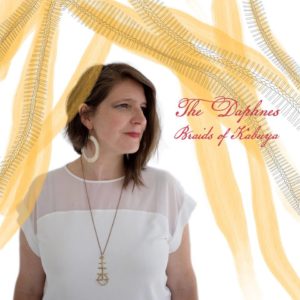
This verse comes from my song, Mood Indigo, which is featured in Braids of Kabuya, book of lyrics. Made as a companion piece to The Daphnes album, Braids of Kabuya, this book of lyrics is a way to follow along with the music, and also enjoy as stand alone reading.
Three years ago I had an unusual encounter at my local coffee shop. I had been in such an awful funk in November 2015. So, one weekday, when I normally worked from home, I resolved to get out of the house and went to my local cafe with my laptop. It was pretty packed with people, so I sat down directly across from someone. She was an older woman reading a new hardback, still wrapped in Elliot Bay Books brown paper. I asked her, “New book?”
As simple as that, we began talking. The book she was reading was by Patti Smith and it opened a small doorway between the two of us. We talked about the book and Patti’s music. This woman had gone to hear Patti read downtown the night before. Music meant so much to this woman. She told me her name was Pam.
Pam had worked for the postal service. She retired early she said, “But for what? I got early retirement and worked hard all my life. Now I don’t know what to do with myself.”
She started off working in Spokane, and was a sort of punk herself. She had dominating male associates, whom she rebelled against in the small ways she could while still keeping her job. There was a lot of misogyny in the 80’s at the postal service she told me. She needed this job because she was on her own. She had wanted to be doing something meaningful and creative in the world but felt trapped and couldn’t find a means to go to school, so she just stayed at the post office because it paid well.
I listened to her, but all the while I was emotionally fragile. I was feeling worried about how I’d pay all of my bills this month. I told Pam what I did for work, that I am a musician and poet, a writer of words and songs. I had made a well-thought out plan over three years that was five-fold. My focuses are: recording;public performances;private events;teaching; and the new addition: healing music.When one source of income didn’t come in, another would. Or so I thought.
https://monicaschley.com
I had recently quit a secure office job in arts administration to pursue my career as a full-time musician. But, at the time, things weren’t manifesting well as a Certified Clinical Musician. I thought I would have had five clients a month by now, but I only had one. It was making a real monetary dig into my small savings and was disheartening. I was starting to get worried. Scared. I also had a young child, and began to think that I had made a dreadful, self-indulgent choice to pursue my art as my career and she would suffer for it.
People have said sometimes its easier talking to a stranger than a friend, and I suddenly found myself speaking candidly to Pam. She was listening closely, in the same way I had listened to her, sitting across from me, with her long hair and thin face. She looked a bit like Patti Smith herself, a grande dame punk.
Because I had my laptop right there, I shared my website with her and some of my writing and recordings. I don’t know how it happened exactly, but suddenly, I found myself weeping. I tried to reign it in, but I had opened the gate. Pam listened so kindly and told me not to give up. That I was on the path to a uniquely rich life and most people didn’t have the bravery to take that kind of leap. She didn’t. She had wanted to, but was too afraid. To my great shock, she reached out her hand and gave me $50!
I couldn’t believe it. I certainly was not expecting anything to come out of our conversion other than that, a simple exchange of words. Instead, I had made a friend and a patron. She wanted to hear more about my shows and my work and asked to be on my mailing list of events that I send out monthly. That simple act of listening would have been enough, but the encouragement she gave me was lovely and fuels my spirits still today. Three years later at Thanksgiving, I still think of this encounter at the cafe with a wonderful stranger.
My daughter was five when this happened. When I would pack up for a gig, she would wave good-bye at the window and say, “Don’t give up!”
I am still not sure why she said that, but I sure needed to hear it. When I shared this story originally on my event mailer, many people wrote back with their own struggles and stories of endurance.
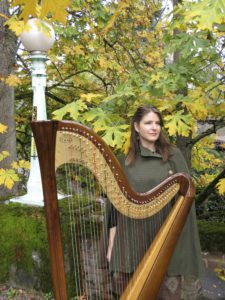
Now, I am in a new place, a better one I think. My work as a therapeutic bedside harpist did pan out, though there have been downs, I notice the ups too and realize that is part of the process. To my surprise, I’ve also become a mom for a second time. The fact that I can continue on with my five-fold plan with another person to nurture is a miracle in itself. My kids are both healthy and they help me to really prioritize my time – the balance of time I spend on my work; the time I spend with them; and how the two can overlap sometimes.
In Patti Smith’s book Just Kids, she describes leaving her home in New Jersey to make a new life as an artist in New York City. When she got to the bus terminal, she realized she didn’t have enough money for fare. She went to a phone booth to call her mother, and when she closed the door, she saw that someone had left her purse in there. Patti took that as a sign. She took just enough money from that purse to pay the rest of her fare and turned in the purse in to lost and found.
I might have given up on my dream had it not been for meeting Pam that day. I don’t know for sure, but I’m glad I kept going. The road isn’t always smooth, but the journey is real and sometimes there is magic.
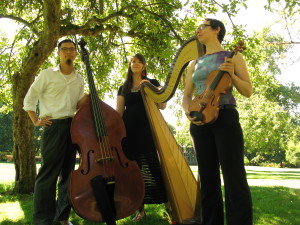
This October 1, The Daphnes will release our first album, Braids of Kabuya. I’m so very excited to have a hard deadline on the calendar! This album sounds amazing.
With a dozen songs and half a dozen collaborators, this project is a culmination of two of my favorite things: music and poetry. Its has been a long time coming and I just need YOUR SUPPORT for the final push.
Nocturne #17, the poem that appeared in the Spring/Summer 2008 issue of Crab Creek Review, is part of a series called Black Eden: Nocturnes. All of the pieces are in prose, and were composed during evening hours, either just before sleep or after waking. They are heavily influenced by the surrealness of dreams, subterranean urban scenes and music. Writing Black Eden was a bit like working in a subconscious mine where I went down and chipped away every night.
Something new happened at the time I was writing this: I didn’t edit. It was as if no filter was the filter, so I there was no judgement on myself. Because of that, the train was able to keep moving. Though I didn’t know what I was doing while I was doing it, the writing felt honest, so I just kept it up with encouragement from a close poet friend. Very importantly, I trusted that there were no accidents in this process, expecting nothing and improvising all along. Stephen Nakmonovich has a great book about these ideas called Free Play: Improvising in Life & Art. After a year had past and I had 70 pieces. Then, I started to edit.
The music part of these poems (nocturne means melancholic evening piece for piano) encouraged me to play while simultaneously reading. Though a musician for most of my life, I’m a shy songwriter, but I used some of the poetry as a springboard for lyrics, which worked better than attempts in the past. Eventually, I called upon a dancer friend and other musicians to turn the piece into a performance.
Black Eden 1
As a shared performance, the poems were given aural space just as much as written space, which is something I feel pretty strongly about. I don’t think every poem has to become a performance piece, but I do believe a good poem has to both sound pleasing and look pleasing. This is not to say good poems are spoken versus written or vice versa – I don’t live in a black and white world. There just needs to be a balance of both expressions, and a writer should be conscious of this in order for the poem to live after she isn’t there to present it.
Donald Hall wrote that “poetry out loud is never quite so beautiful as poetry read in silence”. I don’t agree with this much, but I do think that for a poem to last longer than the poet, it must be read privately. However, I do take his notions to into great consideration (even though in this specific case – because the nocturnes are prose – it was stylistically easier for me to do then say, write a sestina, or even free verse). Hall also wrote that “Keats exists without being spoken. Performance poetry flames out like a match.” Personally, I prefer to have my poetry live somewhere between those two places.
Two Worlds
The narrativity that came out of these Nocturnes are loose and surreal, stemming from a first person perspective in a psychological underworld. In Nocturne #17, the use of woman’s make-up is a way to disguise the real from the unreal. Waking and dreaming are blurred concepts. In truth, the entirety of Black Eden is an exploration of those deep subconscious things we all know but don’t want to, or dismiss in passing moments. It is only when those thoughts ride up to our ears and whisper a little random joke that we might see a connection to something else more conscious and wonder – what!? Where did that come from? I didn’t want to forget all of the randomness in life, because for the most part, I don’t believe its all that random.
Black Eden 2
One last thing that inspired these poems for me was Seattle. I love the city in which I live, even in its worst. And for all of our urban banalities, inconveniences, and stereotypes, I wanted to capture that too. I think that’s something that all artists have the opportunity to do, which is perhaps the greatest challenge: to make sense of the garbage and take beauty from the wreckage – create a new message with your own voice.
That’s how you make diamonds.
Reference:
Hall, Donald. Knock Knock II. American Poetry Review March/April 2005.