“Thank you so much for the soulful music. You were a wonderful asset to our performance!”
Melissa McCall (teacher at Bright Water School)
“Your spiritual, haunting harp and vocals are great!” – June Sekiguchi (curator)
“I like your song list.”
Mimi Boothby (mother of the groom)
“Thank you very much for playing at our wedding. The sound of your harp complimented the chapel atmosphere, and everyone said it was a beautiful ceremony. Thanks again!”
CK & Greg Ruby (bride and groom)
“You were so beautiful. We can’t thank you enough for the beauty that you brought to our wedding and the memories we will have of the event for the rest of our lives. It was just as I imagined when I thought about what I wanted our day to be like. I’m glad that I was able to hear you play the whole time. Thank you for touching my life the way you did I will always remember you.”
Cathi and Rick (bride and groom)
“Our family was soooo thrilled! Thank you!”
Jo Kinney (private event client)
“We very much enjoyed your performance.”
Allie Lemieux (Reeve Shima Attorneys)
“We still have people mentioning your performance at Hugo House in October. You were amazing and I think your music and your poetry that night touched a lot of people.”
Annette Spaulding-Convey (Crab Creek Review Editor)
“Thank you from the bottom of our hearts. You brightened our afternoon and made our day!”
Wardwell Residents
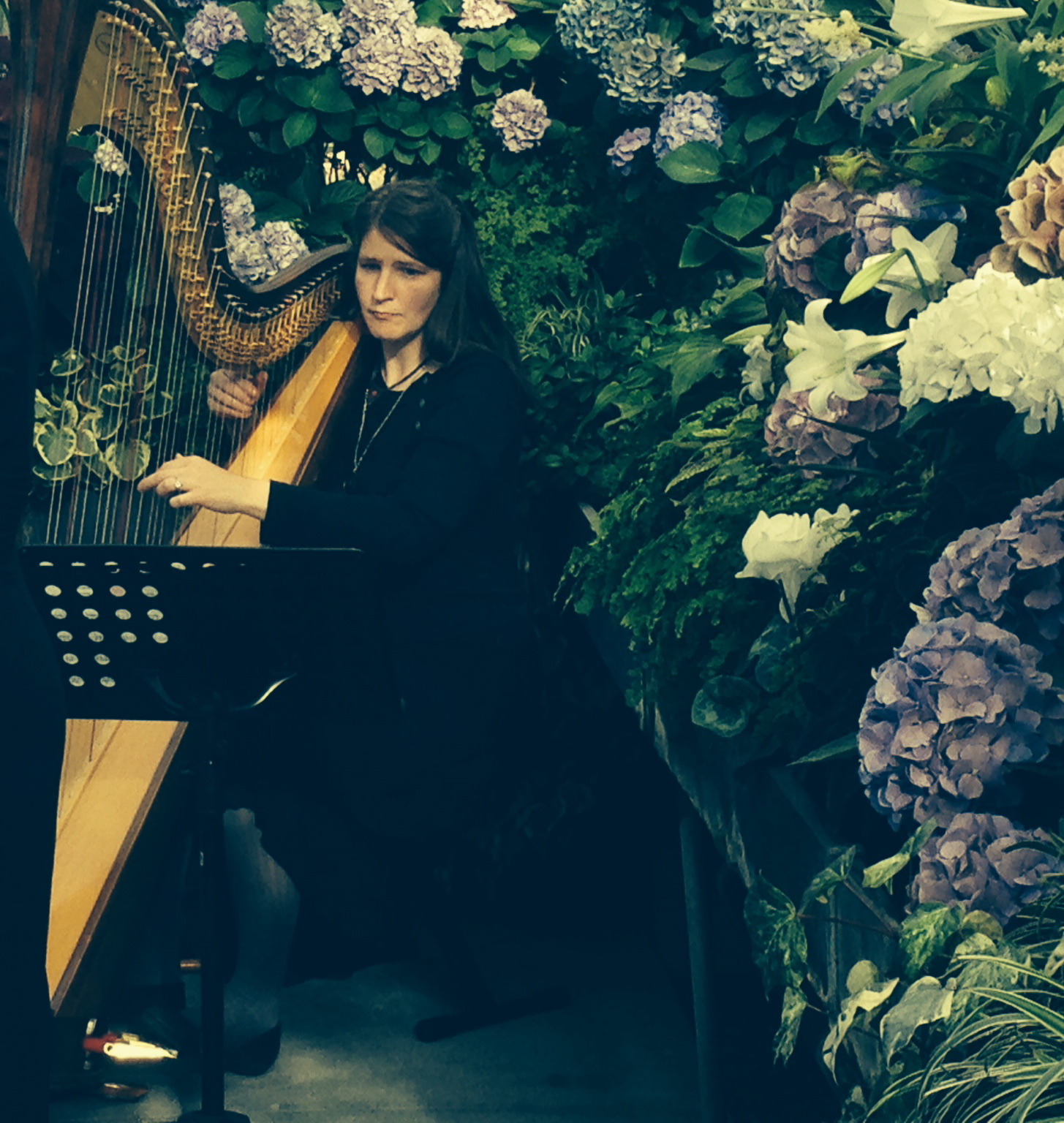
“My dad took this photo while it had a filter on it (without knowing why the color looked off). I think it’s beautiful. Thanks for your lovely music and for talking with me afterwards. I don’t think I will soon forget you.”
Erin Pesut (sister of the groom)
“My work as a therapeutic harpist is a service and not a performance. I don’t expect any kind of recognition,” multi-talented Seattle musician Monica Schley explained when she sat down to discuss her experience as a Certified Clinical Musician. Most of Schley’s musical roles, such as her chamber-pop band, The Daphnes, or role in the experimental pop opera, “Now I’m Fine,” involve performance and entertainment but through her service as a therapeutic musician, she says, she’s found “soul purpose” and improved aspects of her musicianship.
Schley began her journey with the harp at the age of 14. Since then she’s gained mastery of her instrument and acquired a wide repertoire of music which will soon debut on her first full length album “Keep the Night Dark.” Her experience spans classical, chamber, rock, jazz, improvisation and avant-garde. She teaches, composes, and has collaborated with dozens of musicians. Three years ago she did something different. She enrolled in a course in clinical musicianship accredited by the National Standards Board for Therapeutic Musicians. In addition to the coursework she served an intensive internship playing roughly 40 hours in hospitals and kidney dialysis centers and 20 hours in hospice. This is the first year she’s been practicing with full certification. As a therapeutic harpist, Schley says, her ability to memorize music has improved and “It really opened up my ears to how I connect music and sound.”
Schley has played for over 250 patients and each environment calls for a unique marriage of sound and music. “If I go into a room with an oxygen machine or beeping I’m going to play in that scale to avoid disharmony,” she explained. “Like any doctor, I want to make things better and not cause any anxiety. I enjoy that about what I do. I’m attuned to sound. If I’m playing for someone recovering from surgery I choose something with a regular beat and play chord progressions that are soothing. When someone is passing on simplicity is sometimes the best thing. Sometimes I play just one note.”
Schley brings a small 22 string harp with a guitar strap to her therapeutic sessions. She plays for various lengths of time depending on the audience. “What I do is passive,” she said. “I’m never asking anyone to do anything. Sometimes I introduce myself. Sometimes I just play.” Unlike her experience with entertainment and performance, therapeutic music isn’t meant to elicit any audience response except healing and the feedback she does receive is positive. “Monica has shared her incredible harp music with our patients and staff, bringing relaxation, therapy and healing to us all,” writes an R.N. Therapeutic harp benefits everyone listening to it including staff, medical professionals and family. “A lot of the time a family member is in the room and they may enjoy it as well. Sometimes family doesn’t realize—they need it too,” Schley said.
According to the National Standards Board for Therapeutic Musicians therapeutic music enhances a patient’s environment to make it more conducive to healing. “Whether you’re aware of it or not sound goes into your body and organs,” Schley explained. Curing is done by the medical community but healing is facilitated by addressing the emotional, spiritual, mental and physical aspects of life which can be done with the universal language of music. Therapeutic music can relieve stress and tension, augment pain management, reduce blood pressure, aid mental focus, ease transitions, or accelerate healing among other benefits. “I’m happy to be able to use my skill to help people,” Schley said. Clinical musicianship “has helped me in so many ways to be a more compassionate and better person. It’s truly meaningful work.”
This post was originally published at Pyragraph and is reposted here with kind permission.
She nursed on the muse at first, then became her own mother
—Erica Jong, from Self-Portrait
Four years ago, I was digging deep into the music world around me. I was getting calls from jazz, classical and pop ensembles for a regular variety of work and I had just published a book of poetry. I was quite busy and planning for a near future of more of that. Four years ago, I also became a mother. I had no idea what I was about to get into!
Call me naive, but I just wasn’t prepared for the onset of colic in a newborn to last over four months. Every day from 5-8pm my little baby would scream her head off no matter what we did. I thought she was breaking. It was so exhausting that my husband and I began to dread the “witching hour,” as we later learned it is called. That type of mothering dipped severely into my creative flow. I was paralyzed by serious duty, and like so many other artists without an expressive outlet, I got depressed.
Life has definitely improved since that dark winter.
It might have taken me a few years to notice, but I am embracing the fact that though my time to produce/work on my craft has diminished as a mother, the quality of my work and focus on it seems to have increased and improved. I don’t get as much time as I used to, so I make better use of it.
When I was a brand new parent, I was struck with awe at how little time I had for self-care, let alone time to practice my instrument. I searched online for resources from other mothers who are musicians. Indeed, I am not alone out there, but it was difficult to find the self-help/buck-up-kid words I longed for. I needed a mother for my artist me!
About that same time, a mother/musician acquaintance of mine who was living out of the country, started posting on her Facebook page exactly what she did, hour-by-hour, with her two-year-old each day. It was her practice to write out a daily journal of time spent with child/art/family merged together. I thought that was beautiful, and looking back, reading her passages was sort of a turning point for me. I started to do the same in my own private journal—there were good days, challenging days, ideal days, disaster days, and goals to strive for. It also helped me see how I was actually spending my time.
Present day good news: I have a happy four-year-old. I consider that to be the supreme guidepost of any success. Also, my duties have eased up, as she goes to preschool and plays in her imaginary worlds at home. Time has definitely expanded for my creativity to live alongside my mothering duties and I am grateful. Every now and then, I still find it helpful to write out a daily log.
Here’s a recent example of one of our days.
7:00—Woke before the others
7:10—Wrote in my journal
7:30—Made coffee and granola w/berries for the family and me
8:10—Got kiddo dressed
8:45—Prepared sheet music for a rehearsal, tuned and practiced (child playing by herself)
9:30—Went to Musicians’ Union office to photocopy and connect with colleagues (with kiddo)
10:30—Arrived home to rehearse w/ violinist who also has a kiddo—children played; adults played
12:00—Finished rehearsal and hung out for a bit
12:30—Friends left; hubby came home; we all ate lunch together
1:00-1:20—Cleaned up dishes, kitchen and child
1:20-1:45—Hubby took kiddo on a walk so I could message clients/make phone calls
1:45—Got ready to thrift shop and run errands with kiddo
1:55—Abort mission! Bee sting! Child stepped on a bee on the walk!
2:00—Nursed wounded child; applied baking soda compress; ice cream; cartoons
2:20-4:30—Kiddo said she wanted to stay home; worked closely on an activity book together
4:30-6pm—Prepared dinner, ate and cleaned up
6:00-6:30pm—More client emails, writing and invoices
7:00—Drove downtown as a family to hear a musician friend’s house concert
9:15—Dropped off semi-overdue children’s library books
9:30—At home; kiddo fell asleep in the car and plopped peacefully into bed
9:45-11:45—Typed up song lyrics and poems, worked on a writing submission, listened to Self-Employed Happy Hour (a Pyragraph Podcast!), practiced my instrument
I am a Certified Therapeutic Musician. You might ask, what is therapeutic music? And where is it used? You can read the answers to these questions, hear what this kind of music sounds like and more, at my Therapeutic Healing Page Here.
I am recording an album! I’m so thrilled to be working on my first full-length album of original songs.
Entitled, ‘Keep the Night Dark’, this work is a 12-track album reflective of many musical styles: waltz, jazz, Indian raga, ambient drone, do-wop, classical, neo-folk with added vocal lyrics repurposed from my original poems and inspiration from the writings of contemporary Am. poet Anne Sexton, 17th Cent. British mystic William Blake, 18th Cent. French epicurean Brillat-Savarin, Greek mythology, and the world’s first feminist/poet, Sappho.
All songs of KtND were written over the past five years. I am super excited by stellar musicians participating! – my bandmates in The Daphnes (Nate Omdal, bass and Julie Baldridge, violin), plus two amazing drummers (Greg Campbell and Jeremy Jones) and more mystery surprise sound makers!
Harp repertoire of this kind does not readily exist. KtND reflects my wildly wide range of musical tastes. Because I long to play music that covers a broad scope, it took a break from performing to realize the only composer who could fulfill that desire was me!
While recording at Gallery 1412 last week, Greg asked me if I’d always sung. I did. I had. I had just stopped. For about 15 years. When I studied music in college, I thought I should focus on harp. The harp is a complex instrument and I had much to learn. Since it took so much of my time to study, I didn’t have energy to sing. So that was that.
When I stopped performing 5 years ago for a while to have a child, I found myself singing to her all the time. Then, I would write the songs out or record them. Thus, there’s a thematic feeling all the way through that I think comes from subterranean tide pools of maternal emotion. The album also covers general and mythic mother/daughter relations, and nighttime activities like stargazing at constellations and recognition of light pollution.
Soon, Sonarchy Radio will broadcast a session of KtND songs that The Daphnes recorded in June of this year – Stay tuned!
I will also be doing some fundraising concerts for the album this fall as I begin to wrap up the recording process.
Fundraising Concert of November: Harpy Hour – Tues. November 3rd Stone Way Cafe – 3510 Stone Way Seattle, WA 98103 Happy Hour + Harp Music = Harpy Hour 4-6pm $1 off drinks