What a Medieval Mystic Can Teach Us About Wellness

Hildegard von Bingen was an visionary artist, herbalist, healer, writer, philosopher, poet, and composer born at the end of the 12th Century. Her wisdom elevated her to be a highly respected and well-known within her lifetime. What a Medieval mystic can teach us about wellness today is linked to music and plants as medicine.

Like Hildegard von Bingen, I believe herbs (and music) can soothe and heal the body, mind, and spirit. Herbs may or may not cure an ailment, but they can be a balm to what ails you, just as therapeutic music plays a part in a healing process.

Continue reading “What a Medieval Mystic Can Teach Us About Wellness”

On Singing (to Children) at Home

My grandmother (my father’s mother) loved singing while she cooked. Folk songs, church songs, musical theater numbers, whatever popular songs were on the radio at the time – that’s what she sang throughout the day as she did her daily housework. Because it was the 1980’s, I’d hear Linda Ronstadt and Barbara Streisand, Dolly & Kenny mixed in with church hymns. My favorite time of year was Christmas. My aunt played at the piano (and later me), while Gramma, my other aunts, my dad, uncle, and cousins sang in four-part harmony. It felt casual in her house, yet magical to think that our own voices together could make such wonderous music together.

Simple pleasures: campfire songs. There was Jim Croce, Bob Dylan, my dad and his cousins bellowing out “Mr. Bojangles” after a couple of beers. Gramma liked the folk tunes: Red River Valley, Shenendoah, Edelweiss.  She’d sing silly songs too, songs I’d only heard in Betty Boop cartoons, old-fashioned, from a time two generations before me. She’d sing “shoe fly pie and apple pan dowdie makes your eyes light up and your tummy say howdee.” These lyrics were famously amusing to my siblings and me. This one she’d sing while mixing up dough and peeling apple skins. Later, while we at it, ice cream dripping down our chins.

After my grandmother died, I asked my dad what songs she had sung to him as a little boy. He remembered “Nature Boy,” the old Nat King Cole song.

Today, I listened to a podcast from Jeralyn Glass about the healing effects of humming. Even without knowing words or melody to a song, the sound of a simple hum tells the body to create more oxygen and less cortisol (the stress hormone). After a headache, I hum various pitches to make the place in my forehead that hurts, vibrate some. This is, I know from my studies as a Certified Clinical Musician, a type of entrainment. One of the most fascinating stories of entrainment is that of Dutch scientist Christiian Huygens in 1665. His is a famous of example of how two clock pendulums swinging in different began to match in rhythm. In the case of this century’s old science experiment, two inanimate objects have proven that they can synch up in rhythmic time. In my case, I apply my humming voice like salve to sooth the physical pain.

I hum after the most painful part of my headache has subsided. I move my hum up and down in  pitch and volume until it finds a match on the left side of my head. In that place, the hum replaces the witless state of my mind with a gentle touch.

Lately, I have gotten into the habit of playing the radio a lot in the kitchen while I cook and my son plays other side of the room. We keep one another company with the radio songs of my choice (new harp tracks, jazz, classical, the local independent station that plays roots, rock & soul) or his requests – soundtracks to Studio Ghibli or Star Wars movies. I haven’t been singing as much.

After my headache and humming episode, I feel inspired to sing. When my son gets home from school I hum “Nature Boy.” Then, I lazily find the words. Maybe I can remember them? Knowing the words doesn’t really seem to matter while humming. Nature Boy is a short song with a melancholy feel.

My son asks, “What song is that?”  

I tell him it’s a song whose notes sound sad, but the words are about a magical boy. The lyrics have a beautiful message about life. The word for that is bittersweet. Bitter for the way the song sounds, but sweet because of the message in the words: “the greatest thing you’ll ever learn is just to love, and be loved in return.”
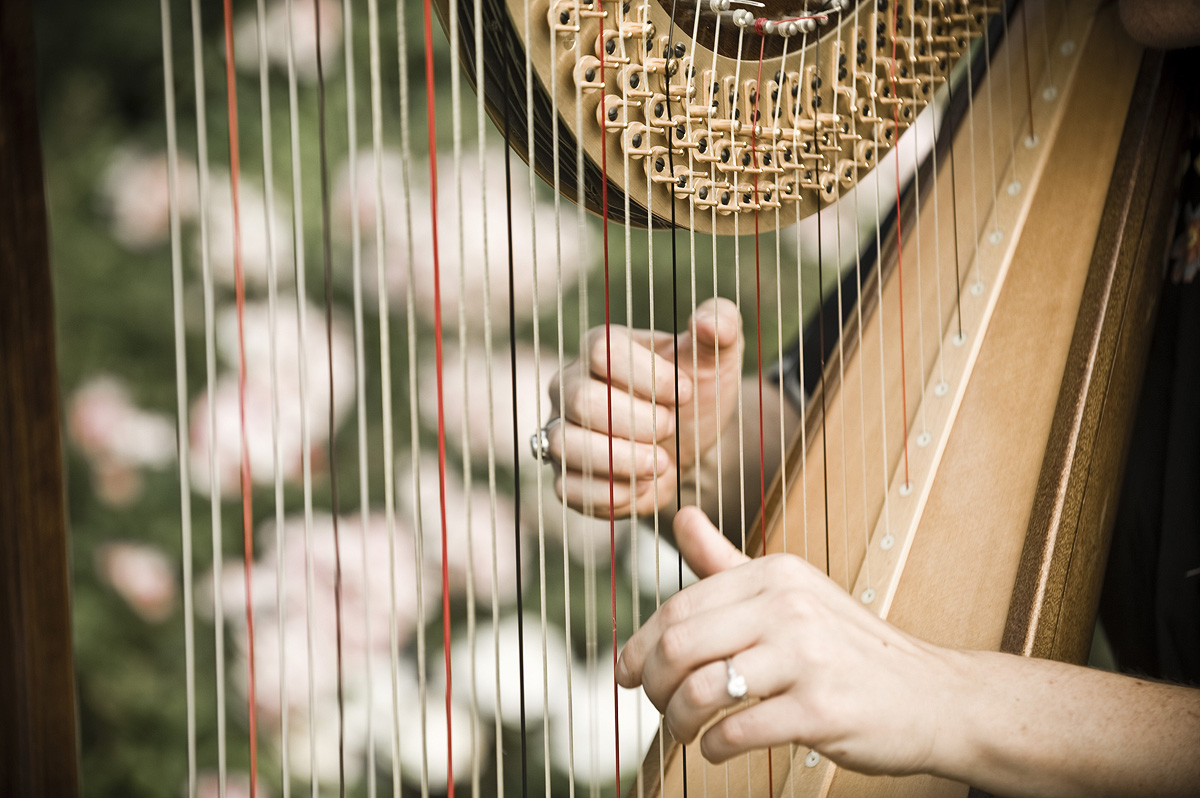
Harp Escape vol. 9 (The Dorian Suite)

In my YouTube series Harp Escape, vol. 9 features (The Dorian Suite), a song I wrote in honor of my young son. Born in 2017, he was just a toddler when the Pandemic hit, and I wrote this song. At the time I was an artist-in-residence at Nalanda West in Seattle, a Buddhist retreat center. There, I spent hours in quietude composing, meditating, and writing in my journal. (Months before wrote a poem inspired by my new baby, later published in Literary Mama.)

When the world was experiencing early signs of the virus, before lockdown, I was at the Nalanda West a couple days a week. It was a place for me to find peace with the unknown. Any parent with young children can tell you, finding time to oneself is a precious commodity. There are many shifts throughout the day, hour by hour, minute by minute. Music and writing have always been a tool for me to get to a happy place and connect with myself and my place in the world. Through searching, through writing music and words, I was able to find an expression for the time and space of 2020, personally and globally. That is a lot of what this song is about.

This piece has several shifts: from Dorian mode to a relative minor (B minor). The meter, or rhythm, changes back and forth from 4/4 to 3/4 time. This is a musical metaphor for how I felt pulled to and fro, as mom, as musician, as person comfortable in the world, as a person uncomfortable in the world.

Here you can listen to Harp Escape vol. 9 (The Dorian Suite).

Harp Escape vol. 9 (The Dorian Suite)

Sheet music for The Dorian Suite, available now at Sheetmusicdirect.com!

How To Let Go of Your Judgmental Inner Music Critic

We are not learning music to be perfect. We are learning music to enjoy the process of playing. We are learning music to develop a skill. Let go of judgement! If you are hearing an inner musical critic and it feels like negative judgement, drop it. Let it go. You don’t want to be holding unto so much baggage.

If that seems too easily said, imagine that your fingers are actually holding onto little bags of judgment (from past/current teachers, conductors, peers, recording engineers, yourself, reviewers, parents, friends, neighbors, etc.). Imagine that these little critiques, each in a bag on your fingers, are weighing you down. They are slowing down your playing. That negativity is taking up physical space and you need to free it up!

Question: What if you got rid of that inner music critic? Answer: Your hands would feel the freedom to put your fingers on the actual notes you need to play.

Drop the mental comment section. Close down the critiques that don’t make you a better player. You can throw them away in the trash bin over there. Now, locate the comments that do help – the ones that say “don’t give up,” or “there now – that wasn’t so hard!”

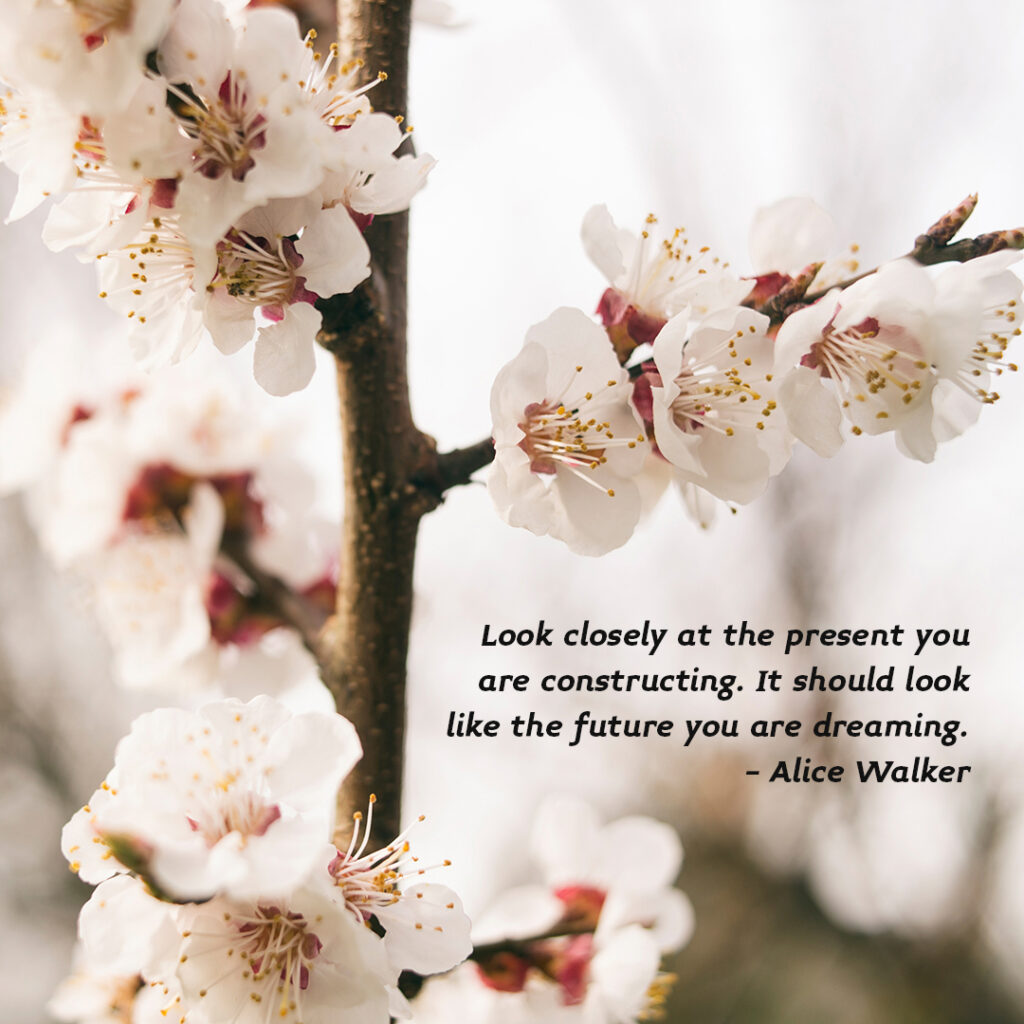
cherry blossoms, Alice Walker quote, miners gold

You can keep the helpful comments, but put them in a safe place at a distance, like picture in a frame. Remember, you want to feel lighter. You want to free up your fingers to do the playing that you were called to do in the first place.

You have work to do. Your work is playful and exploratory.

You are practicing the process of showing up and being ready to play music. Playing music is not about perfection, so much as the journey you take to a place where the playing feels good! This is the work you love to do. By freeing your fingers, you are already doing what you need to do. Now, you are ready to practice!

On Writing and Shopping at Harp Escape Shop

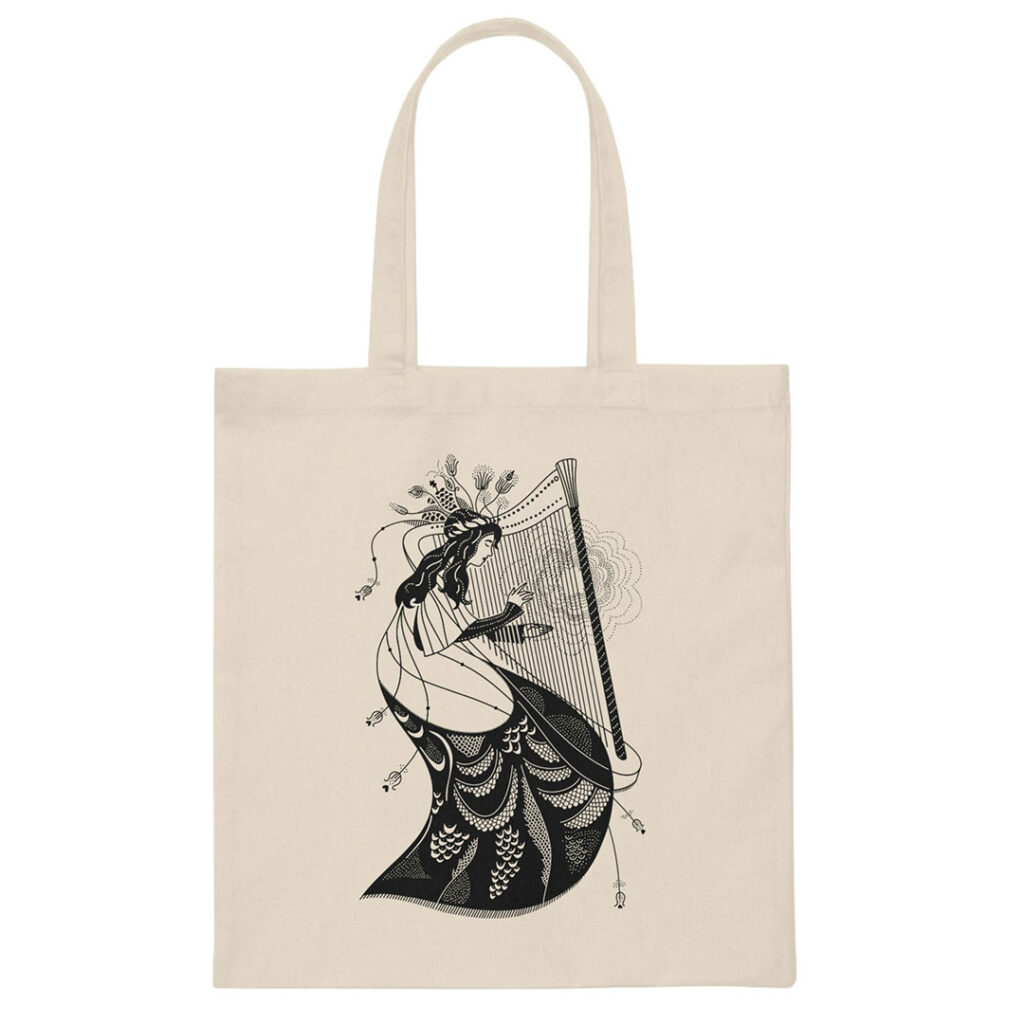
We have added more items up in my Harp Escape Shop! If you didn’t see the 30 day Instagram challenge I did in Feb/Mar you might have missed this gorgeous illustration by Stephen Schildbach. Harp Nouveau was inspired by Aubry Beardsley’s art (but I suppose also being married to me)! Now, you too can own a beautiful cotton tote bag with this lovely harp art nouveau design. $20

Art Nouveau Canvas Tote Bag
Harp Nouveau Tote Bag $20

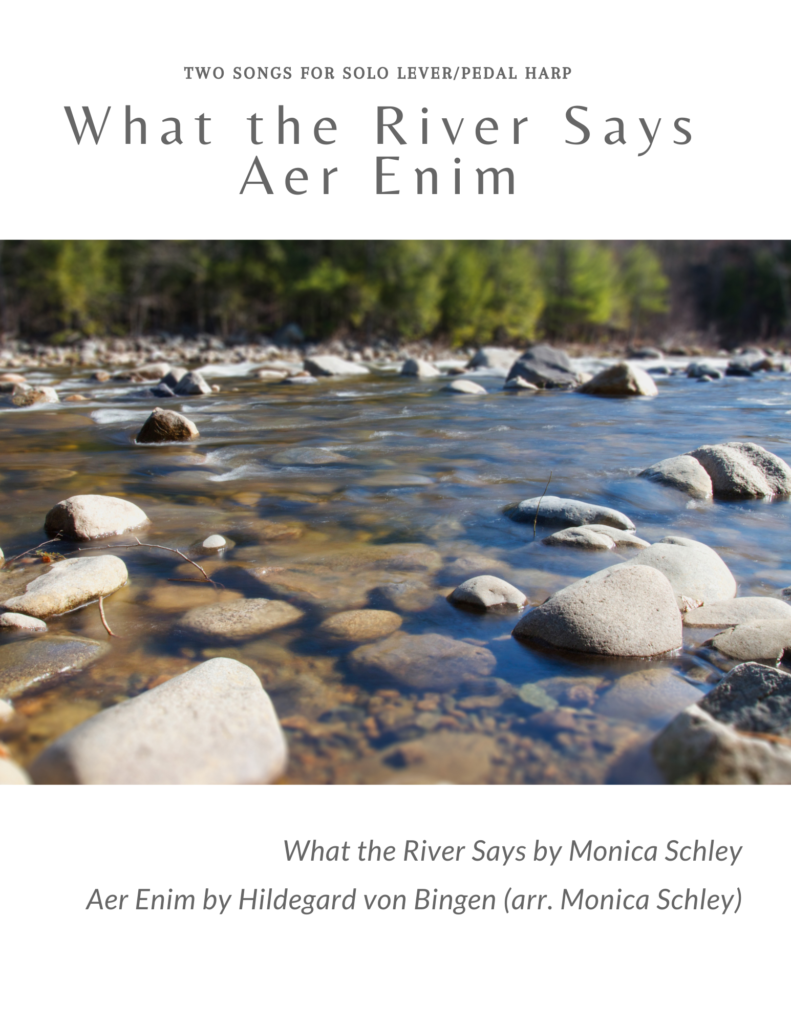
For harpists, I have sheet music for sale. With the song “What the River Says/Aer Enim” you get two for the price of one. Both pieces are arranged for lever and/or pedal harp. This sheet music is for the intermediate harpist in the key of Eb (folk harpers will have to do some extra tuning for this!). This sheet music is for sale for $8.

My tune “What the River Says” is based on the Wm. Stafford poem, Ask Me. The second song, seamlessly merged with the first, was composed by Hildegard von Bingen. If you aren’t familiar with her work, she lived most of her life during the 12th Century, and is considered by many to be the first female composer of Western music. Born in Germany in 1098, Hildegard von Bingen composed music, wrote poetry, and also wrote several books about religion, art, politics, philosophy, science, medicine, and herbs.

This is just the first of many Hildegard von Bingen songs made available to you. I’m arranging an entire collection of her songs for lever harp, coming out next year by Mel Bay Publishing! Some students and friends may already know this. And chances are if you’ve hired me to play a memorial service or quiet ritual, you have heard me play one of these. As I complete working on the book, I’ll be sharing more with you.

Seattle Harpist
What the River Says / Aer Enim Sheet Music (4pgs) $8

And speaking of writing a book… I’ve recently had a poem published! April is National Poetry Month after all, and it feels like a good time to share this. The lengthy title, Poem for My Unborn Boy at the Ballard Locks One Day Before His Birth, (published by Literary Mama) sums up the theme of the poem quite thoroughly. For anyone who has waited for the birth of their child, my go-to technique to get moving 5years ago with my son, was walking stairs at the Locks, over and over again.

The Harp Escape Shop will be undergoing more transformation in the coming months. Feel free to contact me if you run into any bumps in the process.