A Guidepost at Winter’s End

I am driving listing to a poem on KUOW written by Carolyn Wright. She is a Seattle poet I have taken classes with. I perk up because she is about to read a ghazal (pronounced guzzle), a poetic form I happen to be fond of. I am all ears when the poem subject matter is given, the Newton CT shootings. The poem is called “Ghazal for Emilie Parker”. When Emilie’s father, Robbie Parker, spoke about teaching his 6-year-old daughter Portuguese, she was prompted to write the poem.

I am covered in shivers by the time she finishes reading, a litany of the fallen children’s names concludes the poem and am weeping as I reach my destination. As a new mother, I am extremely concerned about the prevolence of violence in America today. I feel old when I say, “it wasn’t like this when I grew up!”

But it’s true.

Our politicians give me little comfort, even though nearly everyone and every measure I voted for last Fall passed.The Sequester has sent a very poor message to America’s people from Washington D.C. and I feel terrified that like The Sequester, America’s politicians may stalemate how we discuss and move forward with America’s serious problem with gun violence. Its up to all of us to chime in, no matter what our opinions are, and tell our legislators what we’d like to see change. Clearly, something must change, and I hope for it to be a succession of wise, compassionate and brave moves.

Contact your U.S. Senators here.

Now, I don’t want to get all preachy on you! But do indulge me. I’m going somewhere I promise.

Candace Pert, a reknowned phychopharmacologist, wrote a book called “Molecules of Emotion”. I happen to be half-way through this book, which is required reading for my therapeutic bedside music program. What I thought would be droll, is a surprisingly exciting autobiography of her work at the top of the scientific world in America. Since the mid 1970’s she has been at the forefront of psychopharmacological study (ie. how the brain responds to phychoactive drugs, naturally occurring in our body and otherwise). She has pressed against an all male establishment since the beginning of her brilliant career, and worked on discoveries that effect cancer and AIDS research, as well as researching what parts of the brain are used when our bodies release natural “feel good” endorphins. In the words of spiritualist and M.D. Deepak Chopra,“Pert was one of the first Western scientists who was able to explain the unity of matter and spirit”, aka the mind, body, soul connection.

She In 1975, she was intentionally left out receiving a of a major award because she was a woman. Instead of burying her head in the sand, as she puts it, she confronted many key players, only to be ostricized by her colleagues. Details in her writing of this actually raised my blood pressure! I share this last bit with you because March is Women’s History Month.

I arrive at home, and decide to Google Candace Pert. I can’t believe what I see. Only yesterday she wrote a very compelling take on the Newtown shootings! What timing! You can read it here.

This article provokes an eloquent suggestion that anti-depressant medication of a certain kind, Selective Serotonin Re-uptake Inhibitor (SSRI’s) should be looked at as an emotional trigger to mass shooter’s psychologies. She asserts there is just as much concern to bring the use of SSRI’s to this discussion as the NRA and gun lobby issue, video games, media/entertainment’s glorification of violence, the flaws of our mental health system, etc. If this interests you at all, I really do encourage the reading of her article (she as far more scientifically eloquent than I!).

Dr. Pert informed me in an email that the following statement is untrue. However… even correct labeling does little good. That said, she points out that the FDA does not insist that drug companies label SSRIs, which according her cause, can have the side-effect of violence! After reading her article, and knowing the back (her)story of what sort of ethically honorable woman she is, I believe that the FDA and Congress need to put some pressure on drug companies; that anti-depressant medications be initially administered by psychologisists exclusively; and that we check in with ourselves quite seriously about the ways in which we allow big corporate advertising to manipulate our rationale. (How many drug commercials do you see on any given TV break suggesting that you can simply ask your doctor for whatever it is that you want and obtain it?)

(Uhmerica by Regina Spektor is an anthem to my country’s gun fascination. My two-year old daughter is Regina Spektor’s biggest fan and she happens to love this song.)

[youtube ohlWZCmTIb4]

“Science is a process, not so much dramatic results,” Pert says. Any artist will tell you the same is true for their artform. Practicing one’s scales is far from glamorous, but an essential part of the process in order to achieve skill. As a harpist, just tuning alone can get annoying and frustrating, but without it, well… forget about it! Practice IS the practice.

Before reading Pert’s book, I had never thought before that the unknowns of running scientific experiments can be compared to making art. The “creator” has the general idea of what they are going for, but not always know how to get there. One may end up discovering something entirely different than planned. There is beauty and meaning is this type of work.

In the creative process, opening up to unknowns can be raw and unnerving, but they often expose a deeper layer to the task at hand. There are signs along they way that tell you you are going in the right direction. When themes happen in life, they’re like personal mini-movies; subject matters that one should be paying attention to.

This happened to me today when several of my interests and “current themes” intersected in an unsuspecting way – Poetry, Violence in America, Healing Arts, Science. I believe that these signs are guideposts that are pointing me toward the right direction at this time.

Starting this month, I’ll begin interning as a harpist-in-residence at NorthWest Kidney Center, playing calming music for patients and staff. My plan is go forward and work at this and other healthcare facilities and do the same. Which ones? I don’t know, but I’m sure there will be a guidepost for me.
On Abundance

Every Thanksgiving I like to read a poem at the dinner table that has me thinking about the zeitgeist of the time or about the season or about family or the concept of gratitude. You get the picture.

This year, I have chosen to read a poem by Margie Piercy, The Sabbath of Mutual Respect.

The poem begins:
Abundance, Habondia, food for the winter,
too much now and survival later. After
the plant bears, it dies into seed.
The blowing grasses nourish us, wheat
and corn and rye, millet and rice, oat
and barley and buckwheat, all the servicable
grasses of the pasture that the cow grazes,
the lamb, the horse, the goat; the grasses
that quicken into meat and cheese and milk,
the humble necessary mute vegetable bees,
the armies of the grasses waving their
golden banners of ripe seed.”

There are many names for the Goddess of Abundance. In this poem, Piercy calls her Habondia. She is also Mother Earth, Demeter, Ceres, and Gaia. Piercy praises the role Earth and of woman. “Praise our choices, sisters, for each doorway / open to us was taken by / squads of fighting / women who paid years of trouble and struggle.”

I chose this poem because of the drastic changes that we as humans are undergoing with regards to technology, social paradigm shifts and political policy. I chose this poem because of the drastic storm that hit the East Coast, Superstorm Sandy, and all of the questions this raises on how and where we live. What does this mean for Earth’s own transformation? I chose this poem because after the recent election we now have more women U.S. senators than ever before! It is a poem that speaks of plentitude, contentment and equanimity.

I praise the Earth this Thanksgiving that I have the opportunity to celebrate with friends and family by eating together. Like most American holidays and the American Dream, it means something a little different to everyone. This year, I chose to celebrate women the world over and give thanks for being born in America with all of our abundant freedoms.

“Doorways are sacred to women for we
are the doorways of life and we must choose
what comes in and what goes out. Freedom
is our real abundance.”


“The Salt-Water Erasures”

I have been asked by Heather Bentley, to read some new poetry coming up on July 8 at the Royal Room. The evening is called Club Shostakovich, which Trio Pardalote will curate.  It is a free evening of chamber music and poetry – sophistication and affordability at their best! Yes. You should come.

csposter1

I’ve been re-working some older poems this spring and summer, I guess mostly because of limited time. I had been toying with the idea about doing some sort poetry experience, when and opportunity to do something in the field (literally, a field!) came my way. I’ll be sharing “The Salt-Water Erasures” first at Club Shostakovich, and then up at Smoke Farm in Arlington, WA for the Lo-Fi Arts Festival. Yes. You should also make a drive to the farm. It is pretty and large and there are few rules to abide by other than to be a decent human being and enjoy yourself. Pretty much the same as any other day, only at a large remote farm with a few hundred artists, so that’s pretty special.

Here’s a little artist statement of where my head is on this subject these past few weeks:

I have been thinking about water of the body – the human body and the Earth body – and how oceans and humans have salt. The equations of salt in most oceans are about 3%, whereas The Dead Sea is a shocking 33%! The Dead Sea has been noted for its unique saline qualities, dating back to the Ancient Greeks who believed in and had stories of Three Muses (or Fates). Sappho, who was Greek, was the first woman poet that we know of and her poems where originally written on papyrus leaves. Over time, the leaves have decomposed and words are missing from the original poems. All translations of her work that we have today are open for interpretation because of this. Like the ocean, time washes away everything we create, yet some things may remain in fragment. Being a new mother, my creative work time has eroded to small bits during the day here and there, rather than large chunks of time. Conversely, I am interested in the sojourn that the creative process takes when revisiting completed work. I plan to revisit the poems I wrote two years ago, when my daughter was in utero (another body of salt water floating in salt water). I will re-write some of the poems and dub them, The Salt-Water Erasures. Erasures are a method of re-writing poetry by literally erasing some of the original words to create something new, almost fragmentary. Some of the poem will have repetition,which will allow for a certain meditative quality to emerge, the way water lapping continuously has for someone sitting at the beach.

Mater Matrix Mother and Medium with Mandy Greer

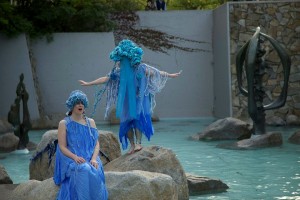
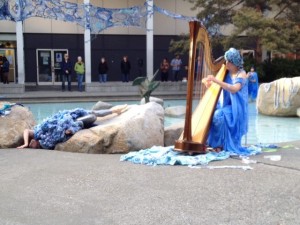
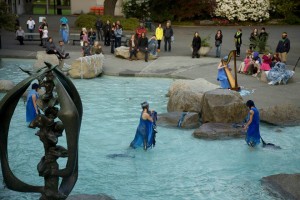
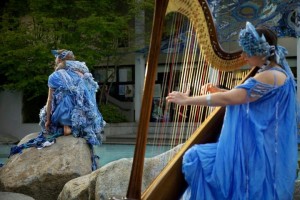
These are some of the photos (taken by Rodrigo Venezuela) from Mandy Greer’s Mater Matrix Mother and Medium performance at Seattle last month, in May 2012. It was a pretty amazing integration of pre-recorded harp and voice with live music performance on top of that; costumes by Mandy Greer; choreography by Jessica Jobaris.

Dupen Fountain
Dupen Fountain
Muse in the Grotto
Muse in the Grotto
Siren
Siren
Spinning Measuring Cutting

Figeater

My poem Figeater (for Beth Fleenor) just got published on the WA State poetry site thanks to our Poet Laureate, Kathleen Flenniken. http://kathleenflenniken.com/blog

Figeater
for Beth Fleenor

That fig tree attracts wasps. They get wobbly
in the heady fermented fruit

flying lazily on the summer wind
like some Sinatra party guest after martinis.

Masts clang down the hill in the harbor.
Another siren calls while the dusk wraps its ethered scarf

around the neighborhood and the raccoon,
in his nocturnal wonder, takes one look at the tree

to see his paradise, his destiny, like a moth
sees his paramour flame, he knows

he will reach supreme love
from the bright fig at the crown

now illuminated by the moon. The limbs
are as soft as quartz, scratching easily

as he climbs up & up & up.
Drawn out is this moment of reaching—

the way he scampers on the thin branches for footing,
stretching towards splendor, there it is: a purple sack,

a Lilliputian’s laundry bag. He touches as high
as he can without falling. And then he does

manage to clip the fruit with his paw
joyously dropping into his mouth, the wet

and juicy center. A smile perhaps
and laughter at the bulging size of the fig

which in one second slides down his throat
but gets stuck. And there is our raccoon—

on tip-toes in the moonlight at the height of his happiness
in the tree choking. After that there is a fall,

followed by the brief silence of being airborne
before landing at the crux of two crossed branches

that bounce of the sudden glottal stop. Uh-oh.

Everyone is gone from the house to have heard
the accident, but in the morning they find him

strange fruit hanging from the Mediterranean tree.
And so he is plucked (apprehensively)

his soft furry body like a forgotten gym bag
stuffed with stinky socks. He is processioned in a bizarre majesty

down the street on the shovel used to dig his grave.
Now he rests in the old apple orchard

of the abandoned house (half burned out in decay)
there beneath the one oak tree covered

in ivy vines that in a few years from now
will have a small fig tree in its shadow

that started from the seed
in the raccoon’s belly.

published in The Far Field