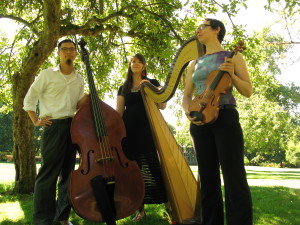
This October 1, The Daphnes will release our first album, Braids of Kabuya. I’m so very excited to have a hard deadline on the calendar! This album sounds amazing.
With a dozen songs and half a dozen collaborators, this project is a culmination of two of my favorite things: music and poetry. Its has been a long time coming and I just need YOUR SUPPORT for the final push.
Nocturne #17, the poem that appeared in the Spring/Summer 2008 issue of Crab Creek Review, is part of a series called Black Eden: Nocturnes. All of the pieces are in prose, and were composed during evening hours, either just before sleep or after waking. They are heavily influenced by the surrealness of dreams, subterranean urban scenes and music. Writing Black Eden was a bit like working in a subconscious mine where I went down and chipped away every night.
Something new happened at the time I was writing this: I didn’t edit. It was as if no filter was the filter, so I there was no judgement on myself. Because of that, the train was able to keep moving. Though I didn’t know what I was doing while I was doing it, the writing felt honest, so I just kept it up with encouragement from a close poet friend. Very importantly, I trusted that there were no accidents in this process, expecting nothing and improvising all along. Stephen Nakmonovich has a great book about these ideas called Free Play: Improvising in Life & Art. After a year had past and I had 70 pieces. Then, I started to edit.
The music part of these poems (nocturne means melancholic evening piece for piano) encouraged me to play while simultaneously reading. Though a musician for most of my life, I’m a shy songwriter, but I used some of the poetry as a springboard for lyrics, which worked better than attempts in the past. Eventually, I called upon a dancer friend and other musicians to turn the piece into a performance.
Black Eden 1
As a shared performance, the poems were given aural space just as much as written space, which is something I feel pretty strongly about. I don’t think every poem has to become a performance piece, but I do believe a good poem has to both sound pleasing and look pleasing. This is not to say good poems are spoken versus written or vice versa – I don’t live in a black and white world. There just needs to be a balance of both expressions, and a writer should be conscious of this in order for the poem to live after she isn’t there to present it.
Donald Hall wrote that “poetry out loud is never quite so beautiful as poetry read in silence”. I don’t agree with this much, but I do think that for a poem to last longer than the poet, it must be read privately. However, I do take his notions to into great consideration (even though in this specific case – because the nocturnes are prose – it was stylistically easier for me to do then say, write a sestina, or even free verse). Hall also wrote that “Keats exists without being spoken. Performance poetry flames out like a match.” Personally, I prefer to have my poetry live somewhere between those two places.
Two Worlds
The narrativity that came out of these Nocturnes are loose and surreal, stemming from a first person perspective in a psychological underworld. In Nocturne #17, the use of woman’s make-up is a way to disguise the real from the unreal. Waking and dreaming are blurred concepts. In truth, the entirety of Black Eden is an exploration of those deep subconscious things we all know but don’t want to, or dismiss in passing moments. It is only when those thoughts ride up to our ears and whisper a little random joke that we might see a connection to something else more conscious and wonder – what!? Where did that come from? I didn’t want to forget all of the randomness in life, because for the most part, I don’t believe its all that random.
Black Eden 2
One last thing that inspired these poems for me was Seattle. I love the city in which I live, even in its worst. And for all of our urban banalities, inconveniences, and stereotypes, I wanted to capture that too. I think that’s something that all artists have the opportunity to do, which is perhaps the greatest challenge: to make sense of the garbage and take beauty from the wreckage – create a new message with your own voice.
That’s how you make diamonds.
Reference:
Hall, Donald. Knock Knock II. American Poetry Review March/April 2005.
On St. Patrick’s Day this year, I played a harp and violin duo gig for an Irish-themed party. My client hosted his 10th annual potato party and hired us to play for a couple hours. As a thank you, I wanted to write him a planxty, an ode in his name, since he was my patron.
In the 18th Century of Ireland, Turlough O’Carolan was one of the most sought after harpists. He was blind and much of the music we have of his today was recorded through the oral tradition. O’Carolan spent most of his career traveling, or wandering, around Ireland staying for a few days at the houses of the well-to-do and playing music. At the time, harps were as popular in a household as guitars, pianos and keyboards are today. So, it was also with these concerts that a touring harper would also stay to instruct members of the family on how to play. At the end of the visit, O’Carolan would sometimes present the head of the household or a family member, with a musical gift (or tribute). This piece of music for the patron composed specially for the occasion was called a “planxty”.
The word planxty means “harp tune of a sportive and animated character” according to the OED. However, the word itself does not sound very Celtic or Gaelic in origin to me, which is why it first caught my ear. There is speculation that it may have Greek origins, and it also has connotations to be specifically for the harp.
Merriam Webster says, its an Irish melody for the harp written in triplets and slower than the jig. There is also inquisition into if planxties are of a particular style. Most of the O’Carolan planxties are in 6-8 time, but there are many in 2-4, 4-4 and 3-4, so it’s not necessarily a specific dance form or meter. No matter its definition, I find it to be an intriguingly antiquated word.
In essence, a planxty is a praise tune for a particular person. It is a tribute to one who is a sponsor, a patron, an inspiration, or in the day of the life of a modern American harpist – a man in Renton, WA of Irish descent who likes to party on St. Patrick’s Day and hire live traditional music. I have finished writing the song and will share it here in a future post.
photo: Malcolm Smith
Footnotes:
Some favorite O’Carolan planxties: Planxty Lord George Brabazon; Planxty Irwin aka Colonel John Irwin; Fanny Power; Bridget Cruise
Quietly working behind the scenes again, I have been spending time with my new baby boy, Dorian Max, who was born on October 29th. He has been a joy, but naturally, being with a newborn leaves mama utterly sleep deprived. My sleep is the wonkiest it has ever been, usually not getting in more winks than 3 hours at a time. Boo Hoo! Oh poor, poor Monica.
I am pleased to say that after a few months on maternity leave, I am returning to the world of teaching harp lessons, performing and harp therapy gigs at a part-time basis. I’m also booking weddings for 2018. If you get in touch with me, please know: Baby guy is my boss for the time being. I WILL get back to you, but it just may not be right away.
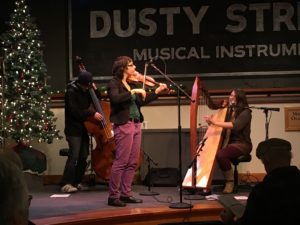
Back in December, at a mere 5 weeks old, he did let me have a show with The Daphnes at Dusty Strings Annual Open House. It was a real treat.
This was previously published in Harp Therapy Journal vol. 22, No. 2 and appears here with the author’s kind permission.
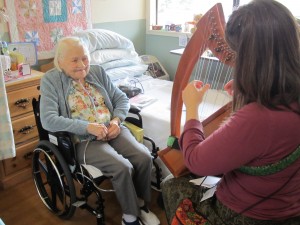
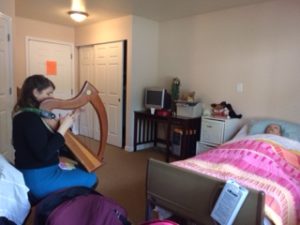
I leave my house with a small 22-string harp. It fits into a soft travel case that I sling over my shoulder. I lay it flat in the trunk of my car easily. I had two pegs drilled into the instrument – one at the neck and one at the base – so I can attach a guitar strap around me when I play, giving me better control and back support. If need be, I can also play standing up for short periods of time. I drive off to see a client in Kenmore who lives about 30 minutes from my house. She is on hospice, but still lives at home.
Some of my patients can’t see. Some of them could see if they were able to open their eyes. Some of them can’t talk. Some compulsively sleep. Some are in wheelchairs. Some talk to me, but their words makes no sense. Some are coherent and can have a discussion with me about a song, a hiking trail or a regional meal, but then next time I visit, it will be as if they never saw be before. Laura is a hospice patient who doesn’t look like she is dying. On my visits, she is alert, engaging and even enthusiastic.
When I get to the door, Laura’s daughter Beatrice answers. “They are waiting for you,” she says.
“They” is Honey, the dog, Laura’s husband Greg, and three of their closest friends, who have card playing friends with for 30 years. I get the back story of who is who as I set up, taking my instrument from its case, and settling into a small couch near Laura. Laura herself, sits in a recliner with her wrapped legs propped up. Other than those bandages and an assortment of pill bottles on the TV tray next to her, there’s no indication that she’s unhealthy. Greg is next to her in his own matching recliner (he has cancer, and like his wife, isn’t a complainer).
“Therapeutic music played live isn’t really a concert,” I say at our first visit.
I say this because everyone is sitting in an arc around me, quietly whispering as if the living room were a theater. I don’t mind that my client has invited friends to be present – these visits are 100% about what they want and what makes them comfortable. I just want to let Laura know that she needn’t feel like this is a performance. She can fall asleep if she wants to while I’m playing, or listen intently, or daydream. Its all good.
Playing for a Regular Hospice Client
Therapeutic music is stylized to the heart’s rate (60-80 bpm) and there are certain intervals and scales that are particularly more relaxing than others. The songs I play vary per individual and situation. In general, therapeutic music is music played live in response to a patient’s needs in the moment. For Laura, who is alert when I see her, I play songs in major keys, both familiar and unfamiliar tunes. I weave them together, so the music is a continuous flow, almost a meandering of musical thoughts with some improvisation.
If the phone rings, or there is a clanging in the kitchen, or a monitor beeps, I meet that tempo, assimilating to my surroundings momentarily, and then either staying at that beat or moving to a more soothing tempo. This is called entrainment. In biology, entrainment is the alignment of one organism’s circadian rhythm to synch up with that of an external rhythm in their environment. When the phone rings for a few pulses, I play the beat gently with my left hand on the bass strings, before Laura’s husband silences the phone. Then, seamlessly, I return to what I was originally playing.
Entrainment was discovered 1665, by a Dutch physicist named Christian Huygens. He made a breakthrough in the field of physics. As he was studying a revolutionizing way of keeping time (the creation of pendulum clocks), he noticed that when two clocks were near to each other on a wall, even if the pendulums swung at different rates, they would eventually synch up swinging at the exact same rate!
If inanimate objects can vibrate together, then of course our bodies are in tune with our surroundings! Entrainment is a sort of vibratory harmonization, and when your body is ailing (or dying) adapting soothing music to the environment of the individual can have incredibly positive side effects.
Harp music has been used therapeutically for centuries. In the past few decades, there has been acknowledgement from Western medical institutions in recognizing therapeutic music benefits, and since the 1990’s there have been a growing number of therapeutic musicians working in healthcare as well as the creation of educational programs offering certifications to musicians. In the United States, the National Standards Board for Therapeutic Music (NSBTM) currently accredits three programs. Under the program, Harp for Healing, I became a Certified Clinical Musician, and I am grateful to now be contracted with a hospice organization in Seattle, Washington.
By my second visit, Honey the dog, has decided she likes me very much. As soon as I sit down on the love seat, she’s resting at my feet.
Laura is generally quiet when I play harp for her. On my third visit, about about 15 minutes into my playing, she speaks up. Astonished, she says, “the pain in my leg went away.”
Like other visits, Laura is on her recliner with her left leg propped up. She has a tumor in that leg she’s named after Sigourney Weaver in Alien. Standing next to her is Beatrice, who says with a wry smile, “Sigourney sleeps.”
Everyone kind of chuckles. I say, “That would make a great song title!”
So, as we talk more about that, I realize I’ve just commissioned myself to write Laura a new piece for our last session. The healthcare provider I work with, gives four sessions of complimentary therapy to hospice patients. Sometimes my clients die before I have a chance to complete our visits, but with Laura, I have the hopeful feeling she’ll be living longer. She seems to have a lot of life in her yet, but I also know better. I have seen many times that death is very unpredictable and someone’s health can decline quickly after just one minor incident. For now, Sigourney is sleeping, so I play only one or two more songs for Laura, since she is pain-free and is in a better place than when I arrived – this is the best that I can hope for her.
Therapeutic Harp at the Bedside
Music is a natural analgesic. There are literally no negative side effects to receiving too much therapeutic music. Medical doctors, social workers and nurses are also beginning to see first hand this benefit. Music offers a personal touch and can add considerable peace to a dying person’s quality of life.
It should be noted (no pun intended) that all music is not the same for this work. Ex: complex chords (jazz); loud guitar noodling (rock) or multi-layered polyphony (orchestral) would be poor fits for the simplistic nature that therapeutic music calls for. That said some classical instrumental music does work, particularly of the Impressionistic Era (if its arranged simply for solo or duo), because of the chordal structures and scales of the pieces. Ex: Debussy and Satie wrote music based upon whole tones scales, which can be very therapeutic, because they touch upon the essence of Western music’s earliest sounds. The whole tone scale is related the Pentatonic Scale (only five notes), invented by the Greek scholar Pythagorus, who in essence invented Western scales (and likely had a hand in the harp’s invention).
With this in mind, therapeutic music must be applied with simplicity of sound, and the intent to improve the condition of another human being. Like any caregiver, it is best to leave a situation as good as, if not better than the way you found it.
The family friends have been resting with their eyes closed, occasionally talking. One person is drawing, another knitting. When I stop playing, people open their eyes and give me soft blissed-out smiles. Honey, the dog, is sad to see me put the harp back in its case. Its time for me to go. For the moment, I can tell my work is done.
About the author:
Monica Schley, CCM, works with Providence Hospice as a Certified Clinical Musician. She is a harpist, poet, mother, songwriter, wedding musician, harp instructor Dusty Strings, bandleader of The Daphnes, and touring artist. As a classically-trained harpist, she has played with jazz luminaries, indie rockers and pop stars. Some of her other writing can be found at www.pyragraph.com. Her personal website is www.monicaschley.com