Therapeutic music is an art based on the science of sound. It is typically live acoustic music, played or sung, specifically tailored for a person’s immediate needs. During this pandemic, though my work as a musician has been severely limited in-person, Harp Escape online has blossomed.
Harp Escape
I have created Harp Escape videos (on YouTube) and audio (made available to Patreon supporters) with the major goal of decreasing stress for my listeners in mind. Benefits of soothing music are many, like allowing the body to relax, unwinding tension, and anxiety relief. Music can also and aid in the healing process. Perhaps one of the most fascinating things I have found in studying music for therapeutic purposes, is that it encourages a listener’s breath to deepen and slow. This relaxation has a domino effect and does several things to benefit our body like:
Love is the end of isolation. Sometimes, when I have meditative moments of insight, I get messages of clarity, wisdom, poetry like this: Stop trying to be normal. The end of isolation is love.
This week, after the virtual school started for my 4th grader, but before the preschool has started for my almost 3 year old, I crumbled in a day of chaos, fallen under the hammering spell of a low-grade stress headache. In respite, I sat on the porch, trying to find some order in my mind, and how to create a new work/live/school schedule all under one roof. Its Quarantine 2.0!
Certain modes, intervals and tempos are favored when playing therapeutic music. Because the harp is one of the most resonant instruments, it makes itself an easy candidate in therapeutic settings. It is mostly made of vibration.
Often, I work with the songs of Hildegard von Bingen who, during Medieval times, frequently wrote modal music. A rare woman composer of the age, her songs are often in Dorian and Phrygian modes – starting the tonic of the musical scale on D or E, instead of C that we are typically used to. This can sound a bit ancient to our modern ears. Each mode is different from the next, depending upon where the half-steps and whole steps are. Combining modal scales with balanced intervals of 3rd, 4th and 5ths can be familiarizing, resonant in our bodies, and harmonious feeling.
Therapeutic musicians want to be
mindful of the particular ailments of the patient we are playing for.
Not everyone needs the same thing, and that person’s needs can also
change in a short amount of time.
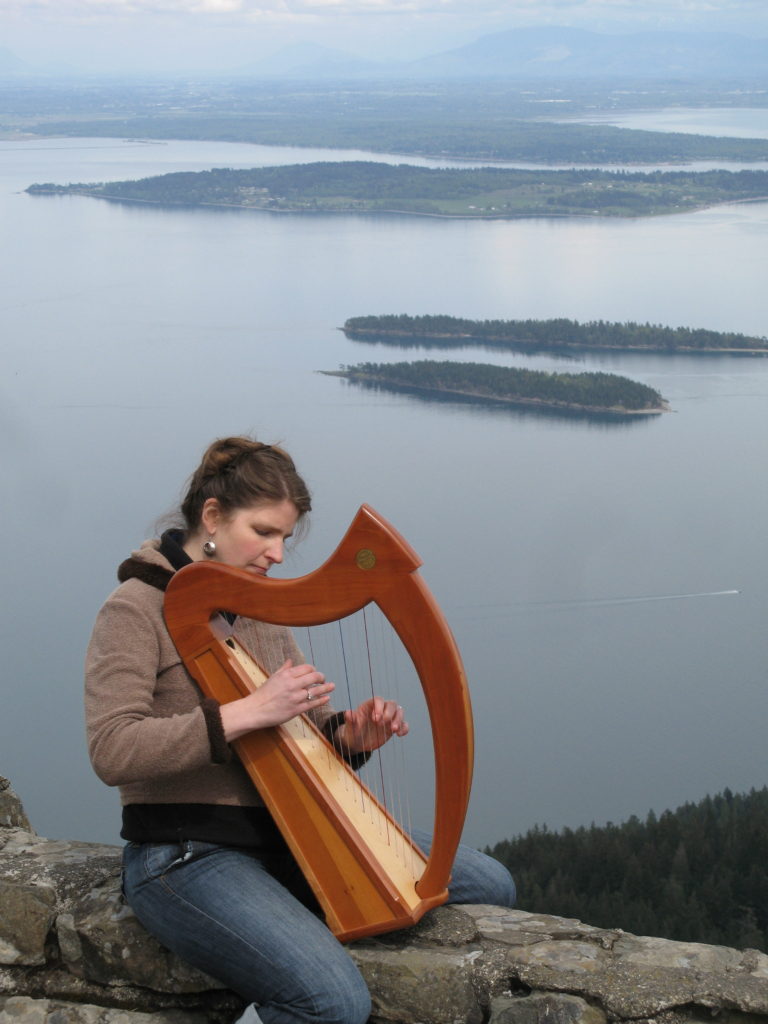
Playing for the Orca whales on top of the world – looking down on the San Juan Islands, WA
Recently, I played for a man suffering from cancer, who was originally from Peru. South American culture is rich in upbeat rhythms. When I arrived playing my small Irish harp (nothing like the Peruvian harp), playing airs and American folk songs, he wanted something much more peppy with quick chord changes. It is atypical for me to play music at a quick tempo at the bedside, yet that is what this client wanted. When I switched styles, he visibly cheered up. It is imperative to look at the patient and harmonize with what they need to hear. If their facial expressions show a displeasure, you would want to change what you are playing, maybe even stop. The quick-paced songs that this client wanted were reminiscent of his youth. That is what made him happy, and that is partially what therapy music is about. Its like a concert for one person with a positive intention.
In contrast, I played for a 95 year old woman who became very emotional when she heard the harp. Her shoulders slumped and she appeared melancholy. She had dementia. When I saw she was crying, I switched to a popular soothing musical choice for harpists – traditional Celtic tunes. She didn’t stop crying. Then, I knew she was experiencing feelings deep inside that couldn’t be expressed otherwise. With her more progressed dementia, she spoke in “word salad”, a sort of unintelligible garble. It must be frustrating and scary to not be able to communicate. Music was helping those repressed feelings be released. When her daughter asked her if she’d like me to stop playing, she said no. Her tears were a relief.
Traditional Celtic music is often very relaxing for a general population.
Having a positive intention behind the
music is a good idea as a musician. Like any caregiver, it is wise to
arrive with no agenda other than to care for the individual in the
moment. If I am lucky, I may even improve their day!
Time is on my side, and yet it is my greatest challenge!
I am always on the lookout for how creative mothers make their way through the world – I don’t have any other day job; my work is based on writing and music and I have two young children.
There is a real need for artist mothers to share in their creative process in my opinion – for encouragement, creative tips, support, and just sharing how its done in a practical sense. The world doesn’t always make it easy for artist moms to continue on their journey once they’ve had a baby. The path suddenly gets very bumpy. The road bottoms out. You don’t know how to go on. I would read Dr. Seuss’s “Oh the Places You Go” to my daughter and think – Oh, this is real. This is exactly what I’m experiencing.
When I had my daughter 8 years ago, I was really searching for some creative support written by and for someone like me. I didn’t find anything of the sort. Now I know of at least three podcasts: Rachel Zucker’s Commonplace;The Longest Shortest Time by Hilary Frank; and musician Laura Veirs’ Midnight Lightning. I still haven’t found any written material that deeply addresses how new mothers adjust their creative process and how to support it, which is not to say that it doesn’t exist. I just know I’d still like to read a book like that. However, when you are multi-tasking making dinner, a hands-free podcast is just the ticket! (and these three mentioned are great).
I used to have a more elaborate system of writing poetry and prose. I would handwrite in my journal, then transfer to a more refined notebook, then type it up, print it out, and workshop the writing. Since having children, I don’t have time to do practically any of that!
With a baby, I always feel like there’s a ticking timer at nap time. I try to squeeze in moments to write or practice, but I never know how long it will be. How long will my creative freedom last? If I start to record, will I be interrupted with a cry? Certainly, when kiddos are school-aged, time opens up. With more than one child, time must be blocked out with more commitment.
I create lists of how to prioritize. There is the weekly one and the daily list. For example today is – #1 practice music for gig tonight; #2 transcribe a piece for Sunday’s Mothers’ Day duet with pianist Josh Rawlings (that I can use for Harp Escape as well); #3 blast out my album to one agency; #4 write something. If I can do that much – that would be AMAZING! I always aim high. Sometimes only one thing gets accomplished, and if someone has a fever or a field trip, forget about it. I have to be real about the current daily situation of food, laundry, school lunch, diapers, etc. that I have.
When I had my first kiddo, I blended my writing and music together, sort of by accident. Once I stopped gigging late night shows, I began songwriting. The poetry morphed into lyrics instead. I had to become selective about what I said yes to. Would I take a club gig at 10pm? No way, not unless it paid well (ha ha ha). Eventually, people stopped asking me, but that’s ok. Because I changed.
I won’t lie. Sometimes I find myself lamenting over the artists who have more freedom than me. It takes so much time to polish a craft and I never feel like I have enough anymore. I don’t have a creative stuckness; I have a restriction. This is interesting though, because motherhood is also the blessing that allowed me to open up into a new form! When I stopped saying yes to all of the club gigs, I put my energy into songwriting. I started singing in public. I wrote enough songs to record an album. I formed a band (The Daphnes) and now I can be leader and call the shots to what fits my lifestyle. I probably wouldn’t have organized it all this way if it had not been for motherhood “restricting” me. Plus, it always seems like half of my songs are inspired in someway by the process of being mom. So – its a two-sided coin. A yin-yang.
I feel like its now or never these days, pretty much all the time. Its sort of Zen, but its also sort of desperate. I am very of the moment. After the baby boy fell asleep today, I checked my email and immediately blasted out a response which has turned into this blog post. It always feels so good to re-purpose something.
Being a musician mama means that I sometimes practice for 5 minutes with a squirming toddler in my lap, I cram in my own practice time between students, or I have to accept that I might be winging it at the gig a little more.
Its maddening! Its terrifying! Its exciting! Its the gift of a lifetime.
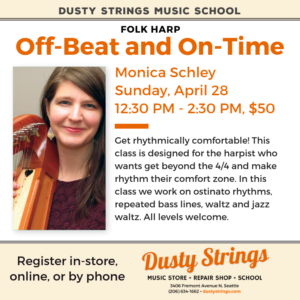
This is a post for the harpists! This month, Sun. April 28, 2019 I will be teaching a rhythm class at Dusty Strings Music School called Off-Beat and On-Time.
Class will be 12:30-2:30
Sun. April 28, 2019
Off-Beat and On-Time = $50
at Dusty Strings Music School
3406 Fremont Ave N
Seattle, WA 98103 (206) 634-1662 – CALL TO REGISTER
In this class we will get rhythmically comfortable! We will work on ostinato rhythms, repeated bass lines, waltz and jazz waltz. First we delve into 4/4 time, practicing ostinato rhythm variations. An ostinato is a repeated rhythm, usually played in bass. Learn how to get into a groove comfortably and in time. Then, we apply the rhythms to two common songs. Next, we move onto 3/4 time, learning a basic waltz. Then, we do a jazz waltz in 6/8 and focus on accented off beats. Finally, we use the 6/8 jazz waltz as a diving board into some improvisation! This class is designed for the harpist who wants get beyond the 4/4 and make rhythm their comfort zone. All levels welcome.
Additionally, I teach private lessons at Dusty Strings. If you live in the Seattle area or are “just visiting” and are wanting to learn more, call the music school today.
I am comfortable with teaching youth as well of students of all backgrounds and ages. My musical method draws from folk, classical, songwriting, theory, ensemble work, improvisation and pop music using a Salzedo-influenced method. I think that everyone’s learning process is a little bit unique, just like the harp.
“I see myself as a musician who happens to play the harp, not being a harpist exclusively. It is from that approach that I tap into the great mystery that is music. I believe teachers can learn from students just as much as students learn from the teacher.”