What do you do when your performance is part of your practice? What does that even mean?
Last month, I had a concert at clothing shop that offered me a place to perform. Acoustically, Golden Afternoon is pretty sweet – high rafted ceilings with wooden beams, clothing on the racks naturally absorbed and softened echoes, and Erin, the woman who owns the shop, set up candles all around. It made for a nice quiet evening. Small. Very small. One could argue attendance was a little too small.
Second Guessing the Performance
Maybe we could have gotten more people there if we advertised better, or if there weren’t other big events happening around town at the same time. However, I felt that we put on a high quality event. Then, I began to think about how performing was a type of practice in its own way. Even the process of getting ready for the gig is a learned practice. How do I know what cords and cables to bring? Will I need rug (for outdoor events)? Do I know what amplifier I’m bringing? If I’m taking the battery powered one, is it charged? Do I need to bring my mic stand and microphone? Do I have printed QR codes and cash if I’m in charge of admission?
At the event, I practiced going with the flow of what people want to hear, in order to make it the best kind of experience for myself and the group as I can. This includes talking to them about what they want to know about the harp. I answered a lot of questions, like: Do you change your pedals while playing? Why yes I do!
I got to show off one of the songs I wrote, Forcythia, which moves left foot and right root together on C and F, down, then up, then C and G, down then up in quarter beats. Usually, people can’t even see what a harpist is doing with her feet. This led to an explanation of the mechanics of the harp. What happens when the pedals move? This became an invitation to move in closer.
Your Instrument is Your Machine
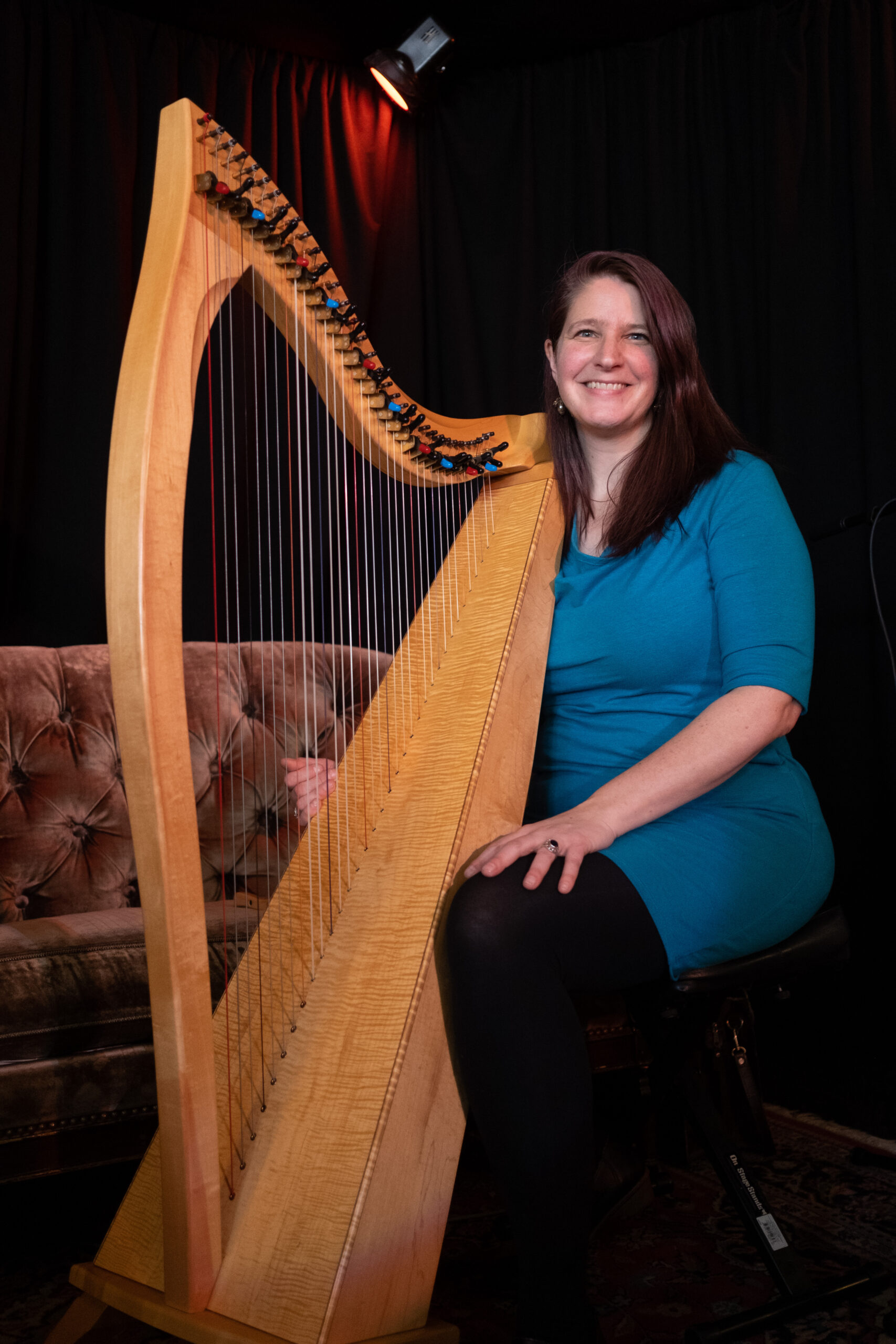
Suddenly, people started to realize that the harp is even more complex than they had thought. I sometimes say that I play a Victorian-era “machine.” The double-action pedal harp was developed in 1810 by Sébastien Érard. This would come to be known as the pedal harp that we see in classical or orchestral settings today. By the mid-19th Century, it was commonly seen in drawing rooms and salons of the upper class.
I tell the audience that I began to think of my harp as a machine two years ago when I broke a pedal rod. On the outside, a pedal harp beautiful, but on the inside it is a most sophisticated musical gadget. There is so much metal inside of it! On the inside, a pedal harp is full of pedal rods, metal plates, and small discs that make the pedals (and even the strings) move.
In my sad sob story, took me over three weeks to get my pedal rod fixed. A pedal rod is a long metal tube that run vertically up the inside of a harp’s column, or pillar. My story was a bit of a marathon, jumping over hurdles like: locating my harp’s specific 3/4 sized rods (a local harpist had only full-sized rods in her Mukilteo shop); the Puyallup repair store is only open part time, so often when I called, there was a 24 hour response delay; fabrication for the 3/4 sided rods had to come from Lyon & Healy in Chicago; parts delivery to Puyallup was delayed by FedEx one day because there was no one there to receive it; then the difficult repair process was slow for the technician because the workspace inside the harp is so small and also a screw on one of the plates had been stripped! I recounted a version of this story at my concert. My main audience members were musicians (one of my bandmates, and the host’s husband who is also my daughter’s calculus teacher). As I told the story, they seemed to have more and more questions as I went on. The harp is so much more complex than the guitars they play!
The Lesson Learned
Overall, I really enjoyed the night, despite a low turnout. I think every musician inevitably plays for a small room, or a room where no one shows up. This is a true test of one’s fortitude for how seriously they want to take themselves as an artist. I also think it can be a unique opportunity for growth as a performer.
To my surprise, the small audience then asked me for a harp therapy style demo. I played very slowly, very quietly, and very gently. I said I would imagine the audience as one of my patients in the hospital. I ended up stopping myself after a few minutes, because I really didn’t want them to fall asleep! I said, this is like music after your yoga class as you lay in shavasana. Then a one woman who I didn’t even notice before piped up and said yes, we’d love you to play after our class! It turns out, she’s an avid yoga practitioner.
We had candles set up and I think there was a least one person who sent me a decent video from the concert. That right there is time well spent.
The overall quality of my concert was fantastic, even if it was played for a small turnout. The lesson learned is that this that I’m better prepared for my next performance. You can book me here for your future event.