Poor Wayfaring Stranger, a Revived Pandemic Song

A version of sheet music for “Poor Wayfaring Stranger” came into my possession in 2020 Lockdown, as I was taking yet another neighborhood stroll. (1/10/22 update: download your own sheet music of this song.) I stopped to look at a Little Free Library. I found an unassuming prayer book (whose name I have since forgotten because I’ve returned the book), and in the back of it were songs with notation, hymnal style. As I spent some time learning “Poor Wayfaring Stranger,” I was intrigued by the somber lyrics and the story they told. The struggle of the character in the song felt very relatable (and still does) compared to what the world has been going through in Pandemic Times.

Seattle Harpist
Hidden gems of the LFL

History of the tune “Poor Wayfaring Stranger” comes from Civil War Era American, folk and gospel. It is possible that the song may have traveled to America with a German immigrant and been adopted into early 19th Century American folk singing. It is also possible that, given the time frame and the gospel nature of this tune, that “Poor Wayfaring Stranger” morphed into a Negro Spiritual, as it has a strong Christian message and speaks of a troubled world.

My solo harp version of “Poor Wayfaring Stranger”

Melodically, this folk tune probably traveled by oral tradition, meaning the notation wasn’t written down. The first time words of the song officially show up in America, they were inscribed inside of Libby Prison by a dying Union soldier. For this reason, “Poor Wayfaring Stranger” was also known as “Libby Prison Hymn,” however that name didn’t stick. More commonly, the song is also known as “Wayfaring Stranger,” “The Wayfaring Stranger,” or “I Am a Poor Wayfaring Stranger.” In the 20th Century, this song was recorded by musicians Johnny Cash, Emmylou Harris, Jack White, and Eva Cassidy.

“Poor Wayfaring Stranger” speaks to the trying times of the human spirit on the verge of death. The tune is part Christian hymn, part prayer, part woeful song, part ode to Everyman’s journey,

If we look at the lyrics (which also have nuances like the title), the 1st verse is:

Continue reading “Poor Wayfaring Stranger, a Revived Pandemic Song”

Wild Dreams and New Beginnings

One of my all -time favorite poets, Laurence Ferlinghetti, the great American bard and book publisher, died this spring just shy of his 102nd birthday. From his poem “A Sweet Flying Dream”
We drifted                       
wafted easily
We
flew wingless
Full of air
our hair
Buoyed us
We
trailed our slim legs
In streams of silver air
There
Was nothing
blowing us down
Or away
From each other

We cannot escape one another. Even though we haven’t been able to physically congregate for a year, we also cannot ignore each other. Though we may feel isolated, worried, and fearful as some of the outer world opens up, we are all floating in this unknown realm together. And if indeed we are flying, it brings us levity and sometimes loss of control. At times it might be easier to just let go.

I have wild dreams about what I’d like to see happen next in my life. Partly encouraged by an artist residency at Centrum; partly in response to the pandemic, I sense a new beginning on the horizon. A new chapter of life for us all is imminent. It is here in fact. There is no holding back, so, best fly with the tricks of our highest ability.

Continue reading “Wild Dreams and New Beginnings”
Harp Escape vol. 5 (Black Orpheus)

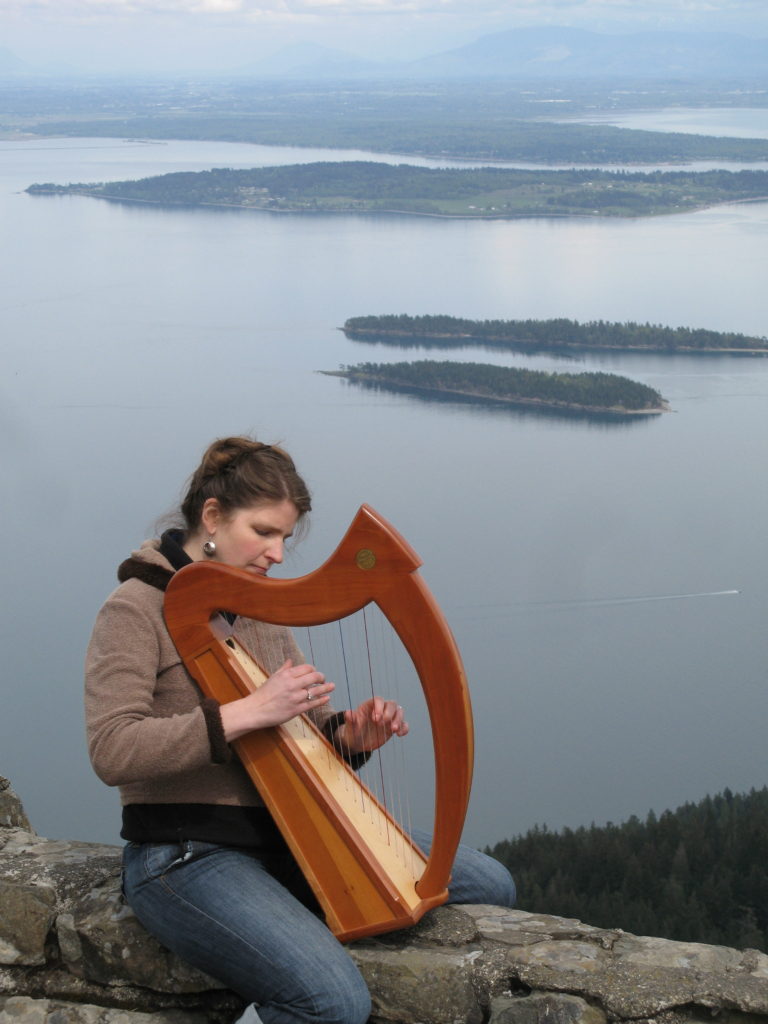
Therapeutic music is an art based on the science of sound. It is typically live acoustic music, played or sung, specifically tailored for a person’s immediate needs. During this pandemic, though my work as a musician has been severely limited in-person, Harp Escape online has blossomed.

Harp Escape

I have created Harp Escape videos (on YouTube) and audio (made available to Patreon supporters) with the major goal of decreasing stress for my listeners in mind. Benefits of soothing music are many, like allowing the body to relax, unwinding tension, and anxiety relief. Music can also and aid in the healing process. Perhaps one of the most fascinating things I have found in studying music for therapeutic purposes, is that it encourages a listener’s breath to deepen and slow. This relaxation has a domino effect and does several things to benefit our body like:

Continue reading “Harp Escape vol. 5 (Black Orpheus)”

The End of Isolation

Love is the end of isolation. Sometimes, when I have meditative moments of insight, I get messages of clarity, wisdom, poetry like this: Stop trying to be normal. The end of isolation is love.

This week, after the virtual school started for my 4th grader, but before the preschool has started for my almost 3 year old, I crumbled in a day of chaos, fallen under the hammering spell of a low-grade stress headache. In respite, I sat on the porch, trying to find some order in my mind, and how to create a new work/live/school schedule all under one roof. Its Quarantine 2.0!

Continue reading “The End of Isolation”

Harp Escape Vol. 3 & 4

Harp Escape is a series of videos and recordings dedicated to relaxing and calming music. What started out in 2019 as a YouTube video series, has turned into a pandemic weekly live concert series (on Facebook) and a new hour of instrumental harp every month (on Patreon).

Recorded in 2019, volume 3 features Erik Satie’s iconic First Gymnopedie.

First Gynopedie (Erik Satie)

A contemporary of Claude Debussy and Maurice Ravel, Satie was also a part of the French Impressionist movement. He was older that the others at that time and somewhat reclusive. He was a bit of a mentor to some of the younger musicians at the time, though his use of whole tone scales was considered unusual. Whole tone scales are based upon the Pythagorean theorum, also known as The Golden Ratio. I think one of the reasons why Satie’s music is so timeless sounding is because they are based upon ancient sounds. These old intervals in the scales are striking because they sound at once soothing, unusual and yet familiar.

Continue reading “Harp Escape Vol. 3 & 4”