I was first introduced to Hildegard’s music as a teenager, and then later in college. When I studied to become a Certified Clinical Musician, I found Hildegard’s music inherently therapeutic. Their simple nature was beautiful to me, but I had trouble finding harp arrangements of her songs. So, I set out to arrange some of the tunes myself. What started as arranging just one song, turned into an entire book of sheet music!
My grandmother (my father’s mother) loved singing while she cooked. Folk songs, church songs, musical theater numbers, whatever popular songs were on the radio at the time – that’s what she sang throughout the day as she did her daily housework. Because it was the 1980’s, I’d hear Linda Ronstadt and Barbara Streisand, Dolly & Kenny mixed in with church hymns. My favorite time of year was Christmas. My aunt played at the piano (and later me), while Gramma, my other aunts, my dad, uncle, and cousins sang in four-part harmony. It felt casual in her house, yet magical to think that our own voices together could make such wonderous music together.
Simple pleasures: campfire songs. There was Jim Croce, Bob Dylan, my dad and his cousins bellowing out “Mr. Bojangles” after a couple of beers. Gramma liked the folk tunes: Red River Valley, Shenendoah, Edelweiss. She’d sing silly songs too, songs I’d only heard in Betty Boop cartoons, old-fashioned, from a time two generations before me. She’d sing “shoe fly pie and apple pan dowdie makes your eyes light up and your tummy say howdee.” These lyrics were famously amusing to my siblings and me. This one she’d sing while mixing up dough and peeling apple skins. Later, while we at it, ice cream dripping down our chins.
After my grandmother died, I asked my dad what songs she had sung to him as a little boy. He remembered “Nature Boy,” the old Nat King Cole song.
Today, I listened to a podcast from Jeralyn Glass about the healing effects of humming. Even without knowing words or melody to a song, the sound of a simple hum tells the body to create more oxygen and less cortisol (the stress hormone). After a headache, I hum various pitches to make the place in my forehead that hurts, vibrate some. This is, I know from my studies as a Certified Clinical Musician, a type of entrainment. One of the most fascinating stories of entrainment is that of Dutch scientist Christiian Huygens in 1665. His is a famous of example of how two clock pendulums swinging in different began to match in rhythm. In the case of this century’s old science experiment, two inanimate objects have proven that they can synch up in rhythmic time. In my case, I apply my humming voice like salve to sooth the physical pain.
I hum after the most painful part of my headache has subsided. I move my hum up and down in pitch and volume until it finds a match on the left side of my head. In that place, the hum replaces the witless state of my mind with a gentle touch.
Lately, I have gotten into the habit of playing the radio a lot in the kitchen while I cook and my son plays other side of the room. We keep one another company with the radio songs of my choice (new harp tracks, jazz, classical, the local independent station that plays roots, rock & soul) or his requests – soundtracks to Studio Ghibli or Star Wars movies. I haven’t been singing as much.
After my headache and humming episode, I feel inspired to sing. When my son gets home from school I hum “Nature Boy.” Then, I lazily find the words. Maybe I can remember them? Knowing the words doesn’t really seem to matter while humming. Nature Boy is a short song with a melancholy feel.
My son asks, “What song is that?”
I tell him it’s a song whose notes sound sad, but the words are about a magical boy. The lyrics have a beautiful message about life. The word for that is bittersweet. Bitter for the way the song sounds, but sweet because of the message in the words: “the greatest thing you’ll ever learn is just to love, and be loved in return.”
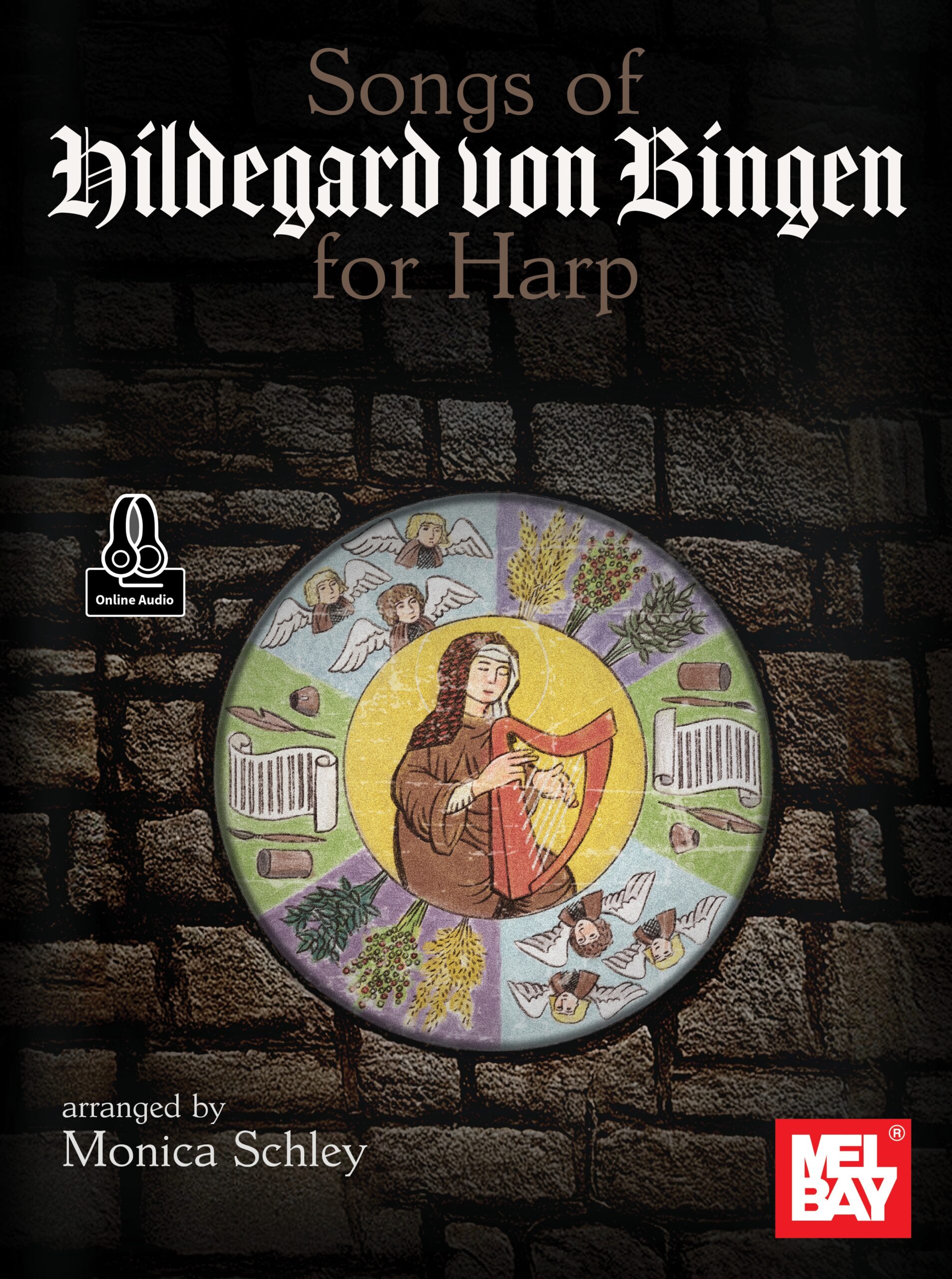
Hildegard von Bingen (1098-1179) was born in Germany during the Middle Ages, at a time when education and literacy were controlled by the Catholic Church. She was an abbess, visionary, prophetess, herbalist, philosopher, healer, writer, politician, poet, and composer.
Despite her claim of lacking formal training in either the Latin language or music, Hildegard produced songs that were equal to those written by the most admired men of the Middle Ages. A woman of letters, she often communicated directly with clergy of the church, including Pope Eugene III, who encouraged her to continue writing music and poetry. She went on to write several books about religion, art, politics, philosophy, science, medicine, and herbs.
Hildegard had visions that she called “reflections of the living light,” and she painted what she saw. She suffered from headaches and some scholars of her writing suspect that she may have She had many visitors at the abbey who claimed that she was able to heal them though touch and with her knowledge of herbal medicine. In time, she had so many visitors, that a larger venue was needed. The church relocated her to an abbey of her own, in Bingen, where she was able to attend to more people. She died there at the age of 81.
How does Hildegard’s music sound on harp?
Originally composed monophonically (or single line melody), Hildegard’s music is usually found as sung choral music. As Latin was written language of the day, her songs reveal a devotional poems. Scales of these songs are modal (most often in Dorian, Phrygian, and Mixolydian modes), the earliest of Western music keys.
I was first introduced to Hildegard’s music as a teenager, and then later in college. When I studied to become a Certified Clinical Musician, I found her music inherent therapeutic. There simple nature was beautiful to me, but I had trouble finding harp arrangements of her songs. So, I set out to arrange some of the tunes myself.
I didn’t seek to make harp arrangements of Hildegard von Bingen’s music overly complex. Because I had the therapeutic musician in mind, I knew these harpists will have a small harp, or a folk harp. I wanted to make this music accessible for as many people as possible, so that if the goal was to play for people with physical, mental, or sleep ailments, they could do that with the harp size available to them.
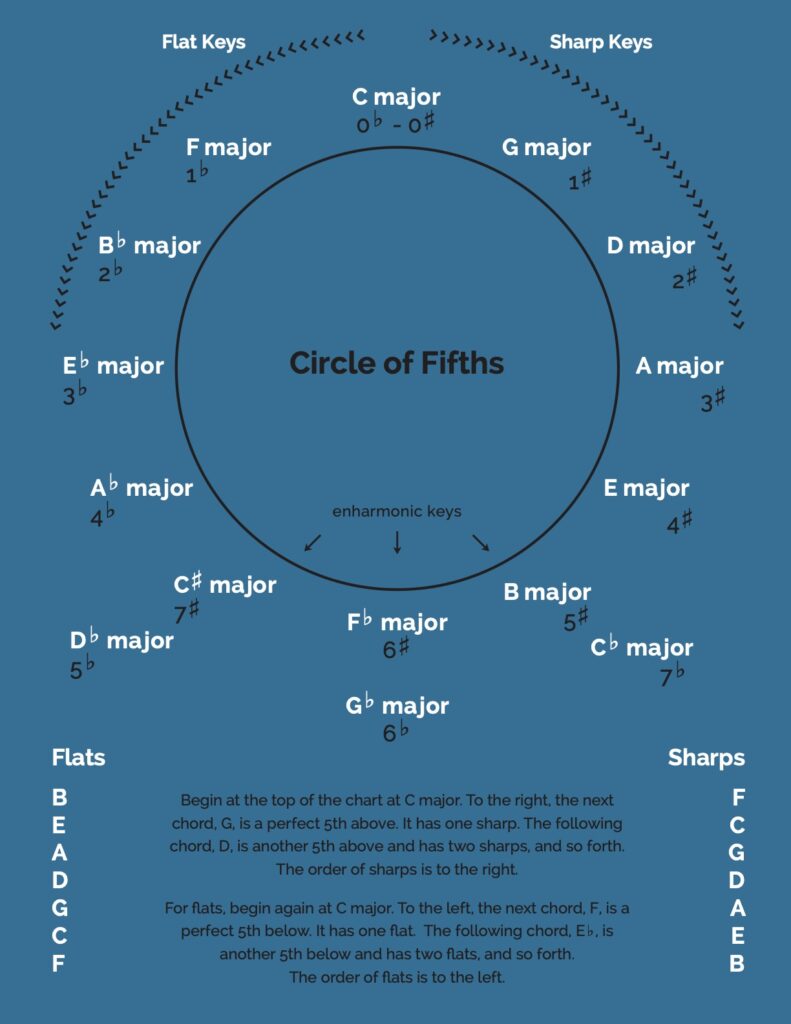
How Do You Understand and Apply the Circle of 5ths? The Circle of 5ths is an often misunderstood concept in music theory. So, I created a class on how to better understand and apply the circle of 5ths to playing music. This online class is available to you anytime on Udemy!
In the class, Circle of 5ths 2.0, you will learn what the Circle of 5ths is and how to apply it to playing the harp. By the end of the course, you will be able to see how it applies to chord progressions and melodic structure. You will review basic hand shapes and technique at the harp as well as: look at a PDF of the Circle of 5th; play exercises for better understanding the order of the Circle of 5ths; practice chordal arpeggios; learn the song “Corinthian Bells” with the melody of the Circle of 5ths; and finally understand how “Fly Me to the Moon” uses the Circle of 5ths.
An arrangement of “Fly Me to the Moon” is available to you with purchase of this online class. The song is divided into an easy and advanced section – perfect for your skill level!
This course is for you if you are new to the harp, are returning to the harp, are interested in learning theory, want to learn a jazz standards, or want to learn specifically about the Circle of 5ths.
In my YouTube series Harp Escape, vol. 9 features (The Dorian Suite), a song I wrote in honor of my young son. Born in 2017, he was just a toddler when the Pandemic hit, and I wrote this song. At the time I was an artist-in-residence at Nalanda West in Seattle, a Buddhist retreat center. There, I spent hours in quietude composing, meditating, and writing in my journal. (Months before wrote a poem inspired by my new baby, later published in Literary Mama.)
When the world was experiencing early signs of the virus, before lockdown, I was at the Nalanda West a couple days a week. It was a place for me to find peace with the unknown. Any parent with young children can tell you, finding time to oneself is a precious commodity. There are many shifts throughout the day, hour by hour, minute by minute. Music and writing have always been a tool for me to get to a happy place and connect with myself and my place in the world. Through searching, through writing music and words, I was able to find an expression for the time and space of 2020, personally and globally. That is a lot of what this song is about.
This piece has several shifts: from Dorian mode to a relative minor (B minor). The meter, or rhythm, changes back and forth from 4/4 to 3/4 time. This is a musical metaphor for how I felt pulled to and fro, as mom, as musician, as person comfortable in the world, as a person uncomfortable in the world.
Here you can listen to Harp Escape vol. 9 (The Dorian Suite).