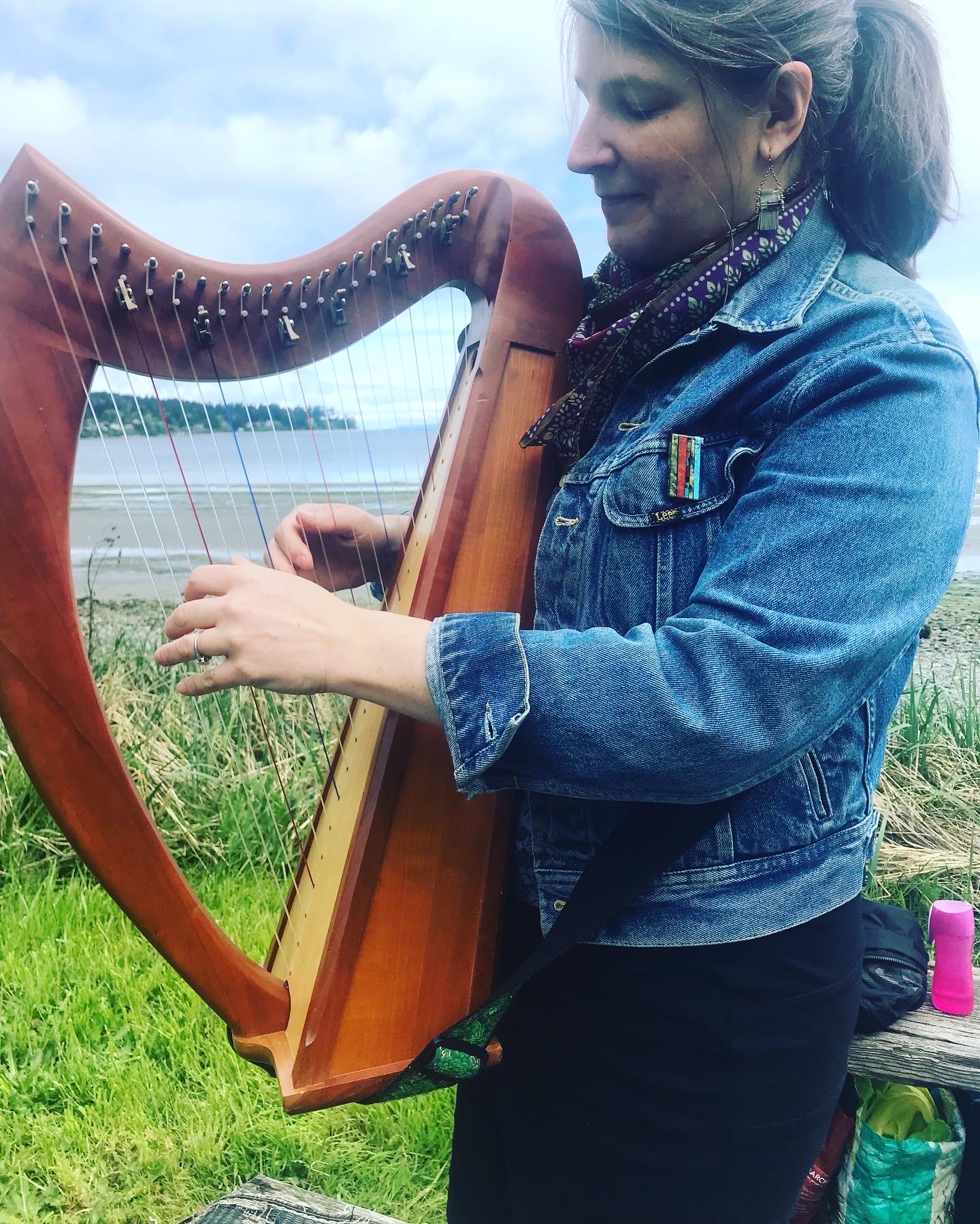
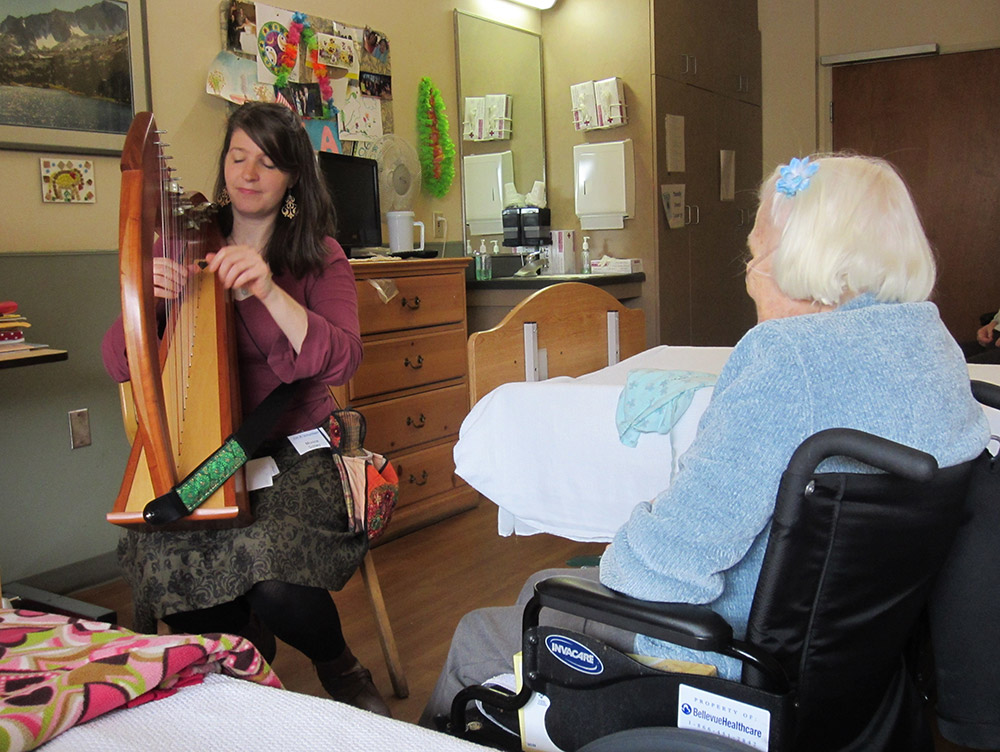
Many musicians, especially those who have taken music history classes and read sheet music, are aware of who Hildegard von Bingen was. I was first introduced to Hildegard’s music as a teenager by my organ teacher, when I was playing for mass. Fast forward a few years, and I went to university where I heard about her again (in music history). I even ended up writing a paper on her. Thirdly, I came across Hildegard’s music when I played harp in hospital and hospice as a Certified Clinical Musician.
Who Was Hildegard von Bingen?
Hildegard von Bingen lived from 1098-1179 in Germany during the Middle Ages, at a time when education and literacy were controlled by the Catholic Church. Hildegard was “given” as a tithing to the church, not an uncommon practice of the time. When she was 14, she was sent to live a life of religious devotion in Disibodenberg.
My grandmother (my father’s mother) loved singing while she cooked. Folk songs, church songs, musical theater numbers, whatever popular songs were on the radio at the time – that’s what she sang throughout the day as she did her daily housework. Because it was the 1980’s, I’d hear Linda Ronstadt and Barbara Streisand, Dolly & Kenny mixed in with church hymns. My favorite time of year was Christmas. My aunt played at the piano (and later me), while Gramma, my other aunts, my dad, uncle, and cousins sang in four-part harmony. It felt casual in her house, yet magical to think that our own voices together could make such wonderous music together.
Simple pleasures: campfire songs. There was Jim Croce, Bob Dylan, my dad and his cousins bellowing out “Mr. Bojangles” after a couple of beers. Gramma liked the folk tunes: Red River Valley, Shenendoah, Edelweiss. She’d sing silly songs too, songs I’d only heard in Betty Boop cartoons, old-fashioned, from a time two generations before me. She’d sing “shoe fly pie and apple pan dowdie makes your eyes light up and your tummy say howdee.” These lyrics were famously amusing to my siblings and me. This one she’d sing while mixing up dough and peeling apple skins. Later, while we at it, ice cream dripping down our chins.
After my grandmother died, I asked my dad what songs she had sung to him as a little boy. He remembered “Nature Boy,” the old Nat King Cole song.
Today, I listened to a podcast from Jeralyn Glass about the healing effects of humming. Even without knowing words or melody to a song, the sound of a simple hum tells the body to create more oxygen and less cortisol (the stress hormone). After a headache, I hum various pitches to make the place in my forehead that hurts, vibrate some. This is, I know from my studies as a Certified Clinical Musician, a type of entrainment. One of the most fascinating stories of entrainment is that of Dutch scientist Christiian Huygens in 1665. His is a famous of example of how two clock pendulums swinging in different began to match in rhythm. In the case of this century’s old science experiment, two inanimate objects have proven that they can synch up in rhythmic time. In my case, I apply my humming voice like salve to sooth the physical pain.
I hum after the most painful part of my headache has subsided. I move my hum up and down in pitch and volume until it finds a match on the left side of my head. In that place, the hum replaces the witless state of my mind with a gentle touch.
Lately, I have gotten into the habit of playing the radio a lot in the kitchen while I cook and my son plays other side of the room. We keep one another company with the radio songs of my choice (new harp tracks, jazz, classical, the local independent station that plays roots, rock & soul) or his requests – soundtracks to Studio Ghibli or Star Wars movies. I haven’t been singing as much.
After my headache and humming episode, I feel inspired to sing. When my son gets home from school I hum “Nature Boy.” Then, I lazily find the words. Maybe I can remember them? Knowing the words doesn’t really seem to matter while humming. Nature Boy is a short song with a melancholy feel.
My son asks, “What song is that?”
I tell him it’s a song whose notes sound sad, but the words are about a magical boy. The lyrics have a beautiful message about life. The word for that is bittersweet. Bitter for the way the song sounds, but sweet because of the message in the words: “the greatest thing you’ll ever learn is just to love, and be loved in return.”
We are not learning music to be perfect. We are learning music to enjoy the process of playing. We are learning music to develop a skill. Let go of judgement! If you are hearing an inner musical critic and it feels like negative judgement, drop it. Let it go. You don’t want to be holding unto so much baggage.
If that seems too easily said, imagine that your fingers are actually holding onto little bags of judgment (from past/current teachers, conductors, peers, recording engineers, yourself, reviewers, parents, friends, neighbors, etc.). Imagine that these little critiques, each in a bag on your fingers, are weighing you down. They are slowing down your playing. That negativity is taking up physical space and you need to free it up!
Question: What if you got rid of that inner music critic? Answer: Your hands would feel the freedom to put your fingers on the actual notes you need to play.
Drop the mental comment section. Close down the critiques that don’t make you a better player. You can throw them away in the trash bin over there. Now, locate the comments that do help – the ones that say “don’t give up,” or “there now – that wasn’t so hard!”
You can keep the helpful comments, but put them in a safe place at a distance, like picture in a frame. Remember, you want to feel lighter. You want to free up your fingers to do the playing that you were called to do in the first place.
You have work to do. Your work is playful and exploratory.
You are practicing the process of showing up and being ready to play music. Playing music is not about perfection, so much as the journey you take to a place where the playing feels good! This is the work you love to do. By freeing your fingers, you are already doing what you need to do. Now, you are ready to practice!
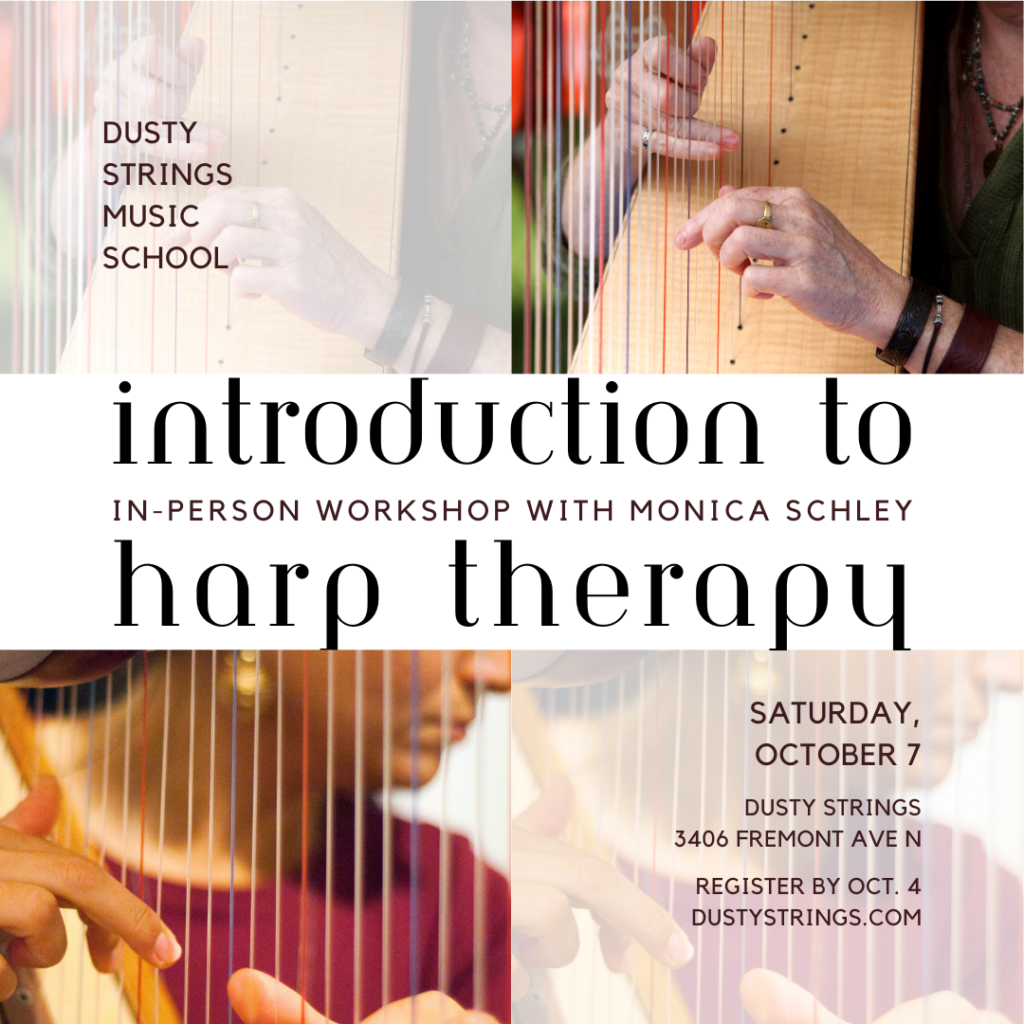
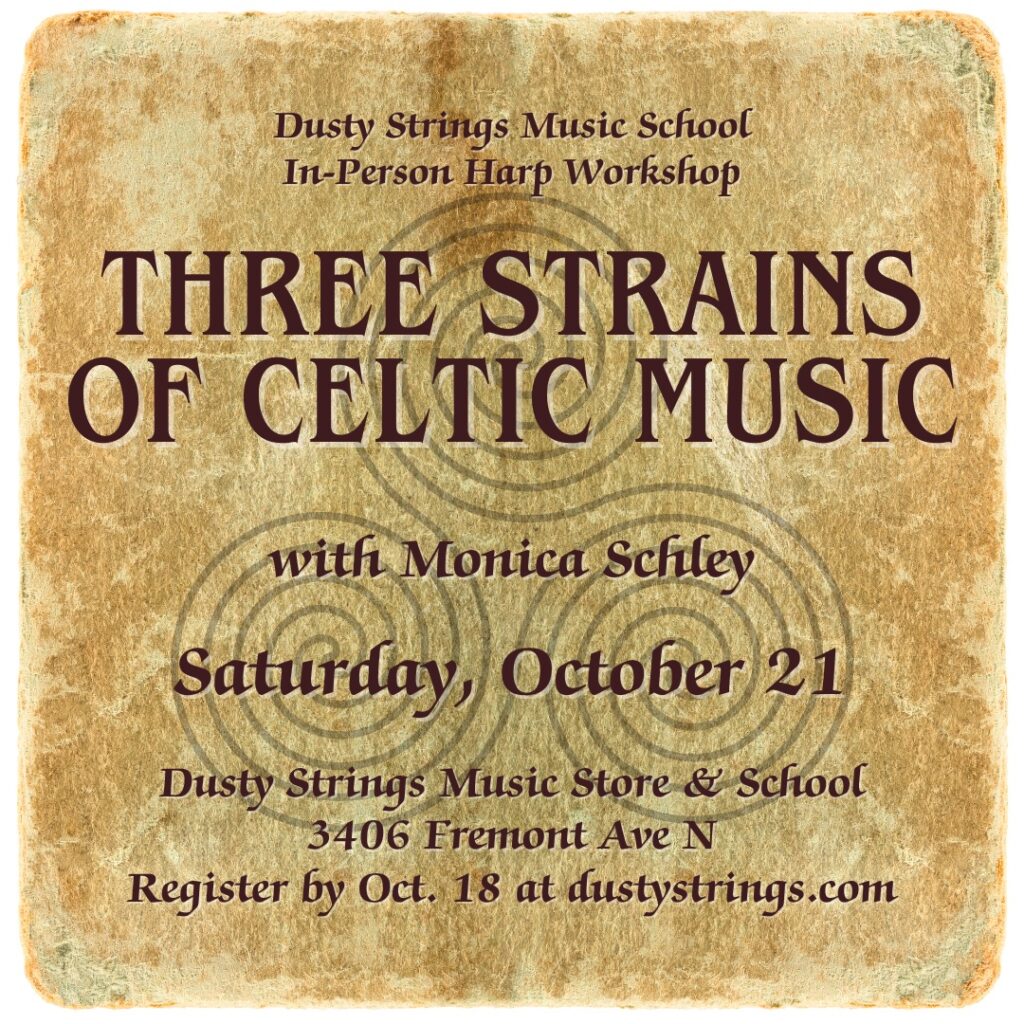
I’m excited to offer two in person workshops coming up in October at Dusty Strings Music School in Seattle (Fremont). Both of these group classes are for the beginner to intermediate harpist.
Sat, Oct 7 – Introduction to Harp Therapy More and more, harpists are lending their hearts and talents to playing healing music, as well as seeking certification to play at the bedside from accredited programs recognized by the National Standards Board of Therapeutic Musicians. In this class, you’ll explore effective styles, modes, and songs to benefit your repertoire, as well as what kind of training you’ll need to play music in health-care facilities.
Skills Needed: For the advanced beginner to intermediate-level player. You should have base of songs you know and a desire to learn new styles for therapy harp. This workshop is designed for those new to therapeutic harp, as well as those in certification programs. It does not certify you to play music at the bedside, but you will learn tools from a Certified Clinical Musician and gain access to references and resources to enrich your harp therapy journey.
Sat, Oct 21 – Three Celtic Strains Join this class for a fun, creative approach to learning more about harp! Irish music tradition recognizes Three Noble Strains, or styles, of playing harp—joy, sorry, and sleep. In this workshop, you’ll learn what these strains are, what they mean, and how to apply them to harp music. You’ll participate in a Celtic Circle of Song, which focuses on chord progressions and playing freely, and add new tunes to your repertoire.
Skills Needed: For the advanced beginner to intermediate-level player. You should have base of songs you know and a desire to broaden your musicality. You do not need to know how to read music, though knowledge of chord charts and some notation is handy.
Previously posted (May 10, 2021), this article has been published in Harp Therapy Journal vol. 28, No. 2 Summer 2023
There are many ways of how to make practicing music a healing process. I’m going to suggest five methods to make your practicing at music a healing process. A good way is to get started with an open mind. Begin with no worries of mistakes, for that will paralyze you from the get go. Besides, mistake are a part of life, we all make them, so you might as well just stay positive. Best to start with some advice from Benjamin Franklin, “Do not anticipate trouble or worry about what may never happen. Keep in the sunlight.”
Let Go
I love hearing and watching a student play through a song in its entirety for the first time during a private harp lesson. As I listen, I’m also watching for other details.That initial play-through, shows a musician’s excitement or nervousness, where the smooth parts and the rocky parts are in the song for them, and how they physically play, hopefully moving in a flow and not being stiff.
During a recent Zoom lesson with an adult student, I noticed that she was holding her breath. To a teacher, this is nothing new. As a young student myself I did this, along with crunching up my face, in concentration. Sometimes, when we focus on one area of the body, like our hands, when we make music, we might stiffen up other “unused” areas of the body, like our face or back. The illusion is that we actually are using all of our body to play.
After the student finished playing, she asked me how she could improve. She was at the point in practicing where she was getting the notes correct and playing with dynamics, but there was something missing. I asked, “Are you holding your breath?”