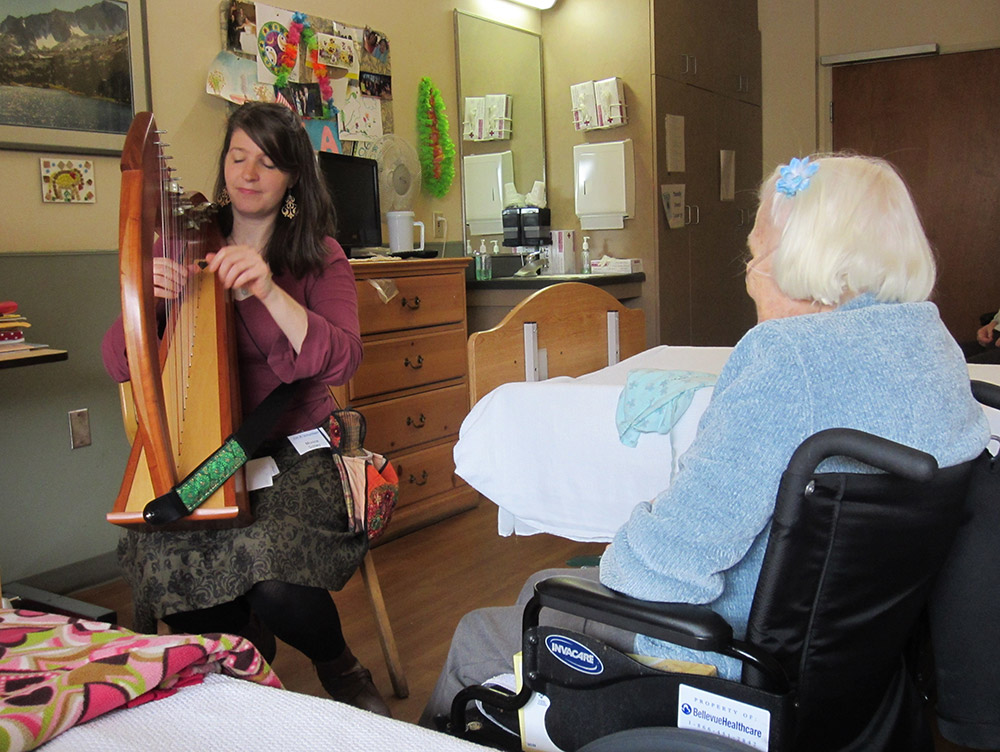
Music can be a tool to aid in healing and relaxation. Relaxing sounds encourage us to deepen our breathing, which in turn can encourage many positive side effects like deepened sleep, decreased anxiety, lower heart rate, and decreased stress. Playing harp music is something I do often as a healing modality for bedside therapy, funerals, rites of passage, and for my children when they are ill or need help falling asleep.
Below are ten ways to use sound and music to improve and heal your life. All of these suggestions include awareness of breath and augmenting of breath. So much of our own wellness is linked to breath.
Music can be a tool to aid in healing and relaxation. Practicing meditation, for example, can be enhanced with music. Relaxing sounds encourage us to deepen our breathing, which in turn can encourage many positive side effects like deepened sleep, decreased anxiety, lower heart rate, and decreased stress.
Below are 10 sounds that can significantly improve and heal your life. All of these suggestions include an awareness and augmentation of breath. So much of our wellness is linked to our breath.
Recently I taught a an online workshop with Atrium Health Foundation called “Improvising with Hildegard von Bingen.” The music is in conjunction with my forthcoming book by Mel Bay Publications, “Songs of Hildegard von Bingen for Harp.” Atrium Health host Kathleen Blackwell-Plank has been curating a valuable workshop series for therapeutic musicians for the past few years. I was asked to teach the class rather last minute as a substitute and was so glad to have participated. After a show of hands, I realized that even in the musical community only half of people know who Hildegard von Bingen is.
So… Who was Hildegard von Bingen?
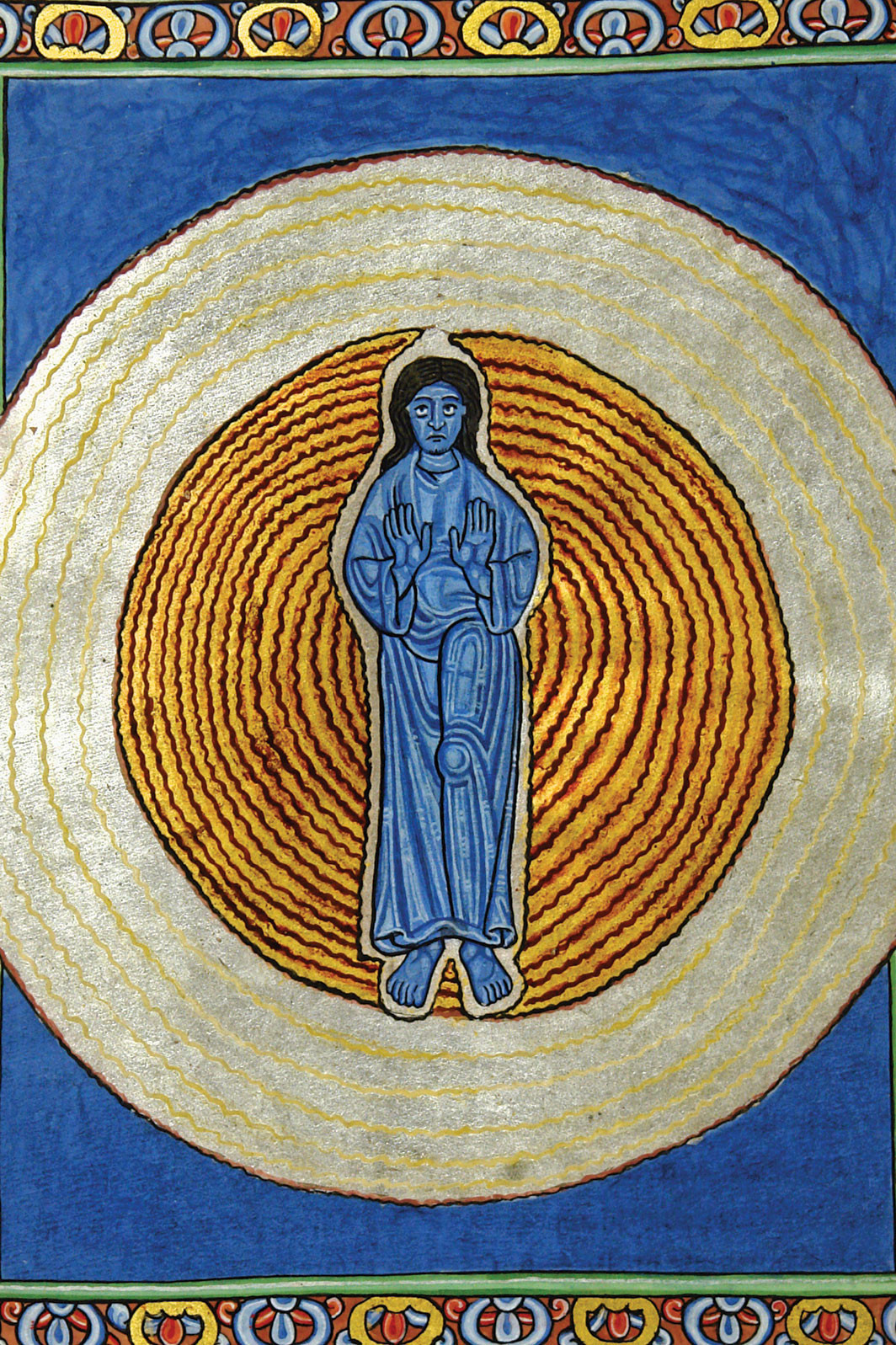
Hildegard von Bingen (1098-1179) was born in Germany during the Middle Ages, at a time when education and literacy were controlled by the Catholic Church. The tenth child in her family, Hildegard was “given” as a tithing to the church, not an uncommon practice of the time. When she was 14, she was sent to live a life of religious devotion in Disibodenberg. At the convent, she prayed, wrote, and only had access to the outside world through the view of a single window.
When her main caretaker, Jutta, died in 1136, Hildegard was appointed prioress of the abbey. It was during that time that she began writing music. Despite her claim of lacking formal training in either the Latin language or music, Hildegard produced songs that were equal to those written by the most admired men of the Middle Ages. A woman of letters, she often communicated directly with clergy of the church, including Pope Eugene III, who encouraged her to continue writing music and poetry. She went on to write several books about religion, art, politics, philosophy, science, medicine, and herbs.
Hildegard had visions that she called “reflections of the living light,” and she painted what she saw. She suffered from headaches and some scholars of her writing suspect that she may have She had many visitors at the abbey who claimed that she was able to heal them though touch and with her knowledge of herbal medicine. In time, she had so many visitors, that a larger venue was needed. The church relocated her to an abbey of her own, in Bingen, where she was able to attend to more people. She died there at the age of 81.
What did her music sound like?
Monophonic (single line melody), choral, sung in Latin, modal (most often in Dorian, Phrygian, and Mixolydian modes), natural minor keys, Gregorian Chant
How does this music translate to the harp?
Beautifully! Hildegard’s music is often in modes and have minimal lever changes.
We are not learning music to be perfect. We are learning music to enjoy the process of playing. We are learning music to develop a skill. Let go of judgement! If you are hearing an inner musical critic and it feels like negative judgement, drop it. Let it go. You don’t want to be holding unto so much baggage.
If that seems too easily said, imagine that your fingers are actually holding onto little bags of judgment (from past/current teachers, conductors, peers, recording engineers, yourself, reviewers, parents, friends, neighbors, etc.). Imagine that these little critiques, each in a bag on your fingers, are weighing you down. They are slowing down your playing. That negativity is taking up physical space and you need to free it up!
Question: What if you got rid of that inner music critic? Answer: Your hands would feel the freedom to put your fingers on the actual notes you need to play.
Drop the mental comment section. Close down the critiques that don’t make you a better player. You can throw them away in the trash bin over there. Now, locate the comments that do help – the ones that say “don’t give up,” or “there now – that wasn’t so hard!”
You can keep the helpful comments, but put them in a safe place at a distance, like picture in a frame. Remember, you want to feel lighter. You want to free up your fingers to do the playing that you were called to do in the first place.
You have work to do. Your work is playful and exploratory.
You are practicing the process of showing up and being ready to play music. Playing music is not about perfection, so much as the journey you take to a place where the playing feels good! This is the work you love to do. By freeing your fingers, you are already doing what you need to do. Now, you are ready to practice!
I had the wonderful opportunity to read my poem, Weather Report on Orange, on the radio thanks to Vashon Island Poet Laureate Margaret Roncone. “Return to Light” features 10 island poets and will be broadcast at 12 o’clock noon on the Winter Solstice, Thursday, Dec. 21, 2023. I am grateful to Margaret, the other poets, and show host, Susan McCabe for this fun opportunity!
The winter solstice is a time for reflection and appreciation of the season, so give yourself a moment of quiet joy during this busy time and tune into KVSH. You can find it online at Voice of Vashon. The show will be available to listen to on the website for 2 weeks. After that, poof!
If you are reading this post after the timeframe has past, you can still read it here:
Previously posted (May 10, 2021), this article has been published in Harp Therapy Journal vol. 28, No. 2 Summer 2023
There are many ways of how to make practicing music a healing process. I’m going to suggest five methods to make your practicing at music a healing process. A good way is to get started with an open mind. Begin with no worries of mistakes, for that will paralyze you from the get go. Besides, mistake are a part of life, we all make them, so you might as well just stay positive. Best to start with some advice from Benjamin Franklin, “Do not anticipate trouble or worry about what may never happen. Keep in the sunlight.”
Let Go
I love hearing and watching a student play through a song in its entirety for the first time during a private harp lesson. As I listen, I’m also watching for other details.That initial play-through, shows a musician’s excitement or nervousness, where the smooth parts and the rocky parts are in the song for them, and how they physically play, hopefully moving in a flow and not being stiff.
During a recent Zoom lesson with an adult student, I noticed that she was holding her breath. To a teacher, this is nothing new. As a young student myself I did this, along with crunching up my face, in concentration. Sometimes, when we focus on one area of the body, like our hands, when we make music, we might stiffen up other “unused” areas of the body, like our face or back. The illusion is that we actually are using all of our body to play.
After the student finished playing, she asked me how she could improve. She was at the point in practicing where she was getting the notes correct and playing with dynamics, but there was something missing. I asked, “Are you holding your breath?”