We are in the darkest time of a very challenging year. As we enter this winter season, we celebrate the light within and travel to inward time. Harp Escape taps into an old use of music, used as sound healing for your self care. Sufi mystic, Hazrat Inayat Khan said “The use of music for spiritual attainment and healing of the soul, which was prevalent in ancient times, is not found to the same extent now. Music has been made a pastime…”
Join me on Patreon for Harp Escape’s Meditative audio recordings, sheet music and more. Once a month, I bring you high quality Meditative Harp Music audio recordings (ranging from 25-55 minutes), a Relaxing Music Video from my harp studio and places in nature, and sheet music arrangements. All of this music is recorded intentionally for you to find a relaxing space for meditation and mindful daily ritual, for you to take a break from the demands of your life and breath deeply, while listening to the healing sounds of the harp’s vibrations.
Therapeutic music is an art based on the science of sound. It is typically live acoustic music, played or sung, specifically tailored for a person’s immediate needs. During this pandemic, though my work as a musician has been severely limited in-person, Harp Escape online has blossomed.
Harp Escape
I have created Harp Escape videos (on YouTube) and audio (made available to Patreon supporters) with the major goal of decreasing stress for my listeners in mind. Benefits of soothing music are many, like allowing the body to relax, unwinding tension, and anxiety relief. Music can also and aid in the healing process. Perhaps one of the most fascinating things I have found in studying music for therapeutic purposes, is that it encourages a listener’s breath to deepen and slow. This relaxation has a domino effect and does several things to benefit our body like:
Harp Escape is a series of videos and recordings dedicated to relaxing and calming music. What started out in 2019 as a YouTube video series, has turned into a pandemic weekly live concert series (on Facebook) and a new hour of instrumental harp every month (on Patreon).
A contemporary of Claude Debussy and Maurice Ravel, Satie was also a part of the French Impressionist movement. He was older that the others at that time and somewhat reclusive. He was a bit of a mentor to some of the younger musicians at the time, though his use of whole tone scales was considered unusual. Whole tone scales are based upon the Pythagorean theorum, also known as The Golden Ratio. I think one of the reasons why Satie’s music is so timeless sounding is because they are based upon ancient sounds. These old intervals in the scales are striking because they sound at once soothing, unusual and yet familiar.
Certain modes, intervals and tempos are favored when playing therapeutic music. Because the harp is one of the most resonant instruments, it makes itself an easy candidate in therapeutic settings. It is mostly made of vibration.
Often, I work with the songs of Hildegard von Bingen who, during Medieval times, frequently wrote modal music. A rare woman composer of the age, her songs are often in Dorian and Phrygian modes – starting the tonic of the musical scale on D or E, instead of C that we are typically used to. This can sound a bit ancient to our modern ears. Each mode is different from the next, depending upon where the half-steps and whole steps are. Combining modal scales with balanced intervals of 3rd, 4th and 5ths can be familiarizing, resonant in our bodies, and harmonious feeling.
Therapeutic musicians want to be
mindful of the particular ailments of the patient we are playing for.
Not everyone needs the same thing, and that person’s needs can also
change in a short amount of time.
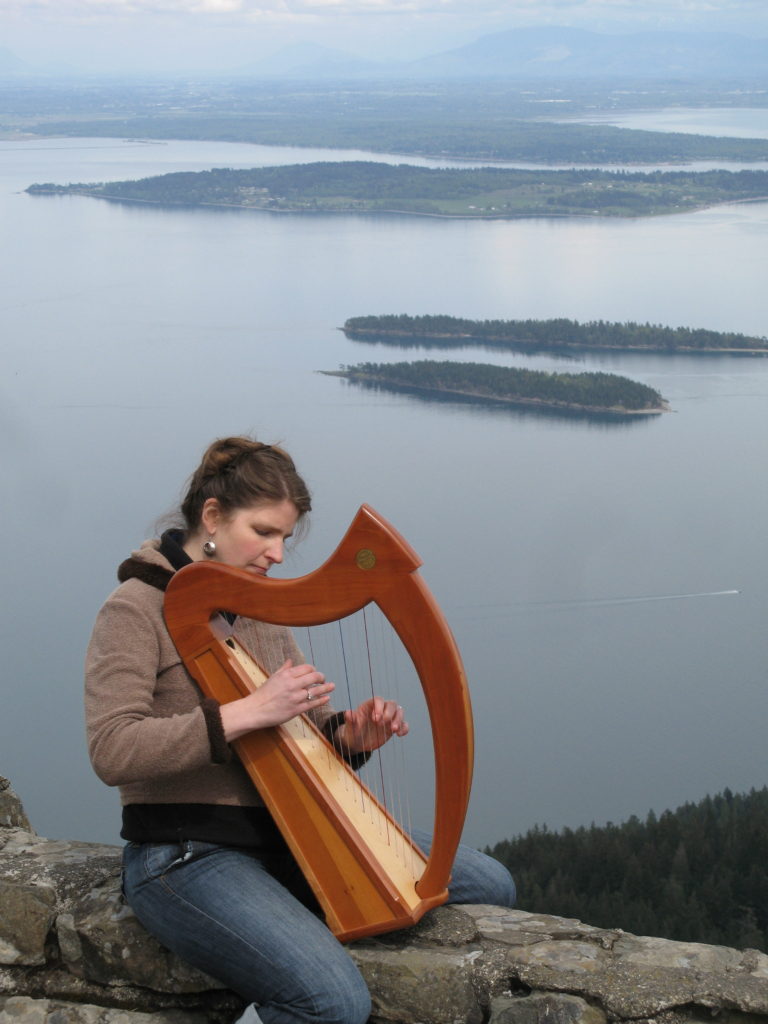
Playing for the Orca whales on top of the world – looking down on the San Juan Islands, WA
Recently, I played for a man suffering from cancer, who was originally from Peru. South American culture is rich in upbeat rhythms. When I arrived playing my small Irish harp (nothing like the Peruvian harp), playing airs and American folk songs, he wanted something much more peppy with quick chord changes. It is atypical for me to play music at a quick tempo at the bedside, yet that is what this client wanted. When I switched styles, he visibly cheered up. It is imperative to look at the patient and harmonize with what they need to hear. If their facial expressions show a displeasure, you would want to change what you are playing, maybe even stop. The quick-paced songs that this client wanted were reminiscent of his youth. That is what made him happy, and that is partially what therapy music is about. Its like a concert for one person with a positive intention.
In contrast, I played for a 95 year old woman who became very emotional when she heard the harp. Her shoulders slumped and she appeared melancholy. She had dementia. When I saw she was crying, I switched to a popular soothing musical choice for harpists – traditional Celtic tunes. She didn’t stop crying. Then, I knew she was experiencing feelings deep inside that couldn’t be expressed otherwise. With her more progressed dementia, she spoke in “word salad”, a sort of unintelligible garble. It must be frustrating and scary to not be able to communicate. Music was helping those repressed feelings be released. When her daughter asked her if she’d like me to stop playing, she said no. Her tears were a relief.
Traditional Celtic music is often very relaxing for a general population.
Having a positive intention behind the
music is a good idea as a musician. Like any caregiver, it is wise to
arrive with no agenda other than to care for the individual in the
moment. If I am lucky, I may even improve their day!
The world is full of static and noise, subliminal, and actual. Online. Offline. In our minds and in our streets. Garbage trucks and jackhammers. Nagging conversations and bills. Deadlines and confrontations.
Harp Escape is a respite from the chaos. It is an online aural get-away.
Twice a month, I will bring you new music videos from my harp studio. This music will be played with intention for a relaxing moment, for you to take a break from the demands of your life and breath deeply, while listening to the healing sounds of the harp’s vibrations.
As a Certified Clinical Musician, I have studied how certain intervals, musical modes, and tempos can have a particularly soothing effect. I will merge this ancient healing knowledge with my skills as a life-long musician and harpist of 25 years. I am a songwriter, an improviser, and I will be arranging particular songs for the intent of a healing Harp Escape.
Sound is vibration. Sound vibrates water. Humans are composed of 75% water. Therefore, we too vibrate from the sounds in and around us. Because there is so much stress and noise in our modern world, I feel it is imperative right now to pay attention to the sounds around us.
A New Journey
Harp Escape is an online place to relax. A virtual experience of the harp cannot take the place of a live session, but in this way, I will be able to reach more people.
Our eyes have lids, but our ears do not. We have no way to say “no” to displeasing sounds; therefore, it is essential that we become aware of when our world is too noisy and too stressful. It is important for our good health that we contrast the harmful sounds with pleasing ones, because they will relax us. Through relaxation we can unwind our nerves and return to a healthy homeostatis.
As I begin this journey of bringing you new calming arrangements of harp music, my goals are:
Upload videos twice per month
Share themes, chosen either by me or by you
Offer sheet music arrangements of particular songs