Music can be a tool to aid in healing and relaxation. Relaxing sounds encourage us to deepen our breathing, which in turn can encourage many positive side effects like deepened sleep, decreased anxiety, lower heart rate, and decreased stress. Playing harp music is something I do often as a healing modality for bedside therapy, funerals, rites of passage, and for my children when they are ill or need help falling asleep.
Below are ten ways to use sound and music to improve and heal your life. All of these suggestions include awareness of breath and augmenting of breath. So much of our own wellness is linked to breath.
Music can be a tool to aid in healing and relaxation. Practicing meditation, for example, can be enhanced with music. Relaxing sounds encourage us to deepen our breathing, which in turn can encourage many positive side effects like deepened sleep, decreased anxiety, lower heart rate, and decreased stress.
Below are 10 sounds that can significantly improve and heal your life. All of these suggestions include an awareness and augmentation of breath. So much of our wellness is linked to our breath.
Recently I taught a an online workshop with Atrium Health Foundation called “Improvising with Hildegard von Bingen.” The music is in conjunction with my forthcoming book by Mel Bay Publications, “Songs of Hildegard von Bingen for Harp.” Atrium Health host Kathleen Blackwell-Plank has been curating a valuable workshop series for therapeutic musicians for the past few years. I was asked to teach the class rather last minute as a substitute and was so glad to have participated. After a show of hands, I realized that even in the musical community only half of people know who Hildegard von Bingen is.
So… Who was Hildegard von Bingen?
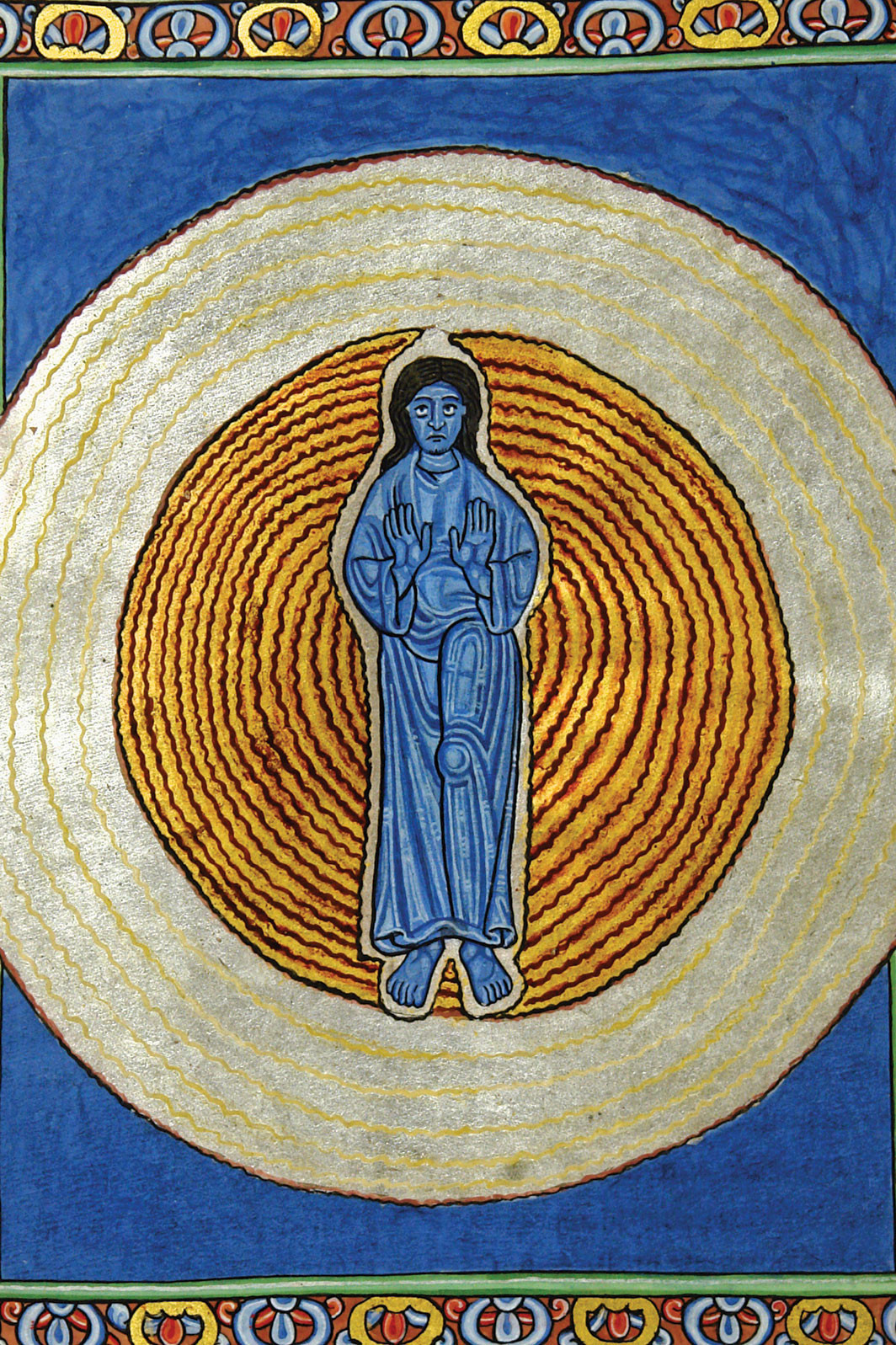
Hildegard von Bingen (1098-1179) was born in Germany during the Middle Ages, at a time when education and literacy were controlled by the Catholic Church. The tenth child in her family, Hildegard was “given” as a tithing to the church, not an uncommon practice of the time. When she was 14, she was sent to live a life of religious devotion in Disibodenberg. At the convent, she prayed, wrote, and only had access to the outside world through the view of a single window.
When her main caretaker, Jutta, died in 1136, Hildegard was appointed prioress of the abbey. It was during that time that she began writing music. Despite her claim of lacking formal training in either the Latin language or music, Hildegard produced songs that were equal to those written by the most admired men of the Middle Ages. A woman of letters, she often communicated directly with clergy of the church, including Pope Eugene III, who encouraged her to continue writing music and poetry. She went on to write several books about religion, art, politics, philosophy, science, medicine, and herbs.
Hildegard had visions that she called “reflections of the living light,” and she painted what she saw. She suffered from headaches and some scholars of her writing suspect that she may have She had many visitors at the abbey who claimed that she was able to heal them though touch and with her knowledge of herbal medicine. In time, she had so many visitors, that a larger venue was needed. The church relocated her to an abbey of her own, in Bingen, where she was able to attend to more people. She died there at the age of 81.
What did her music sound like?
Monophonic (single line melody), choral, sung in Latin, modal (most often in Dorian, Phrygian, and Mixolydian modes), natural minor keys, Gregorian Chant
How does this music translate to the harp?
Beautifully! Hildegard’s music is often in modes and have minimal lever changes.
I had the wonderful opportunity to read my poem, Weather Report on Orange, on the radio thanks to Vashon Island Poet Laureate Margaret Roncone. “Return to Light” features 10 island poets and will be broadcast at 12 o’clock noon on the Winter Solstice, Thursday, Dec. 21, 2023. I am grateful to Margaret, the other poets, and show host, Susan McCabe for this fun opportunity!
The winter solstice is a time for reflection and appreciation of the season, so give yourself a moment of quiet joy during this busy time and tune into KVSH. You can find it online at Voice of Vashon. The show will be available to listen to on the website for 2 weeks. After that, poof!
If you are reading this post after the timeframe has past, you can still read it here:
We come to rituals to commemorate a moment in time, an event, or a loved one: a birth, love, a death. Often music plays a part in these rituals. Harp music in particular can be a meaningful addition to any ceremony. You need harp music for rituals and rites of passage. My work playing music for several decades at rites of passage and ceremonies of all sorts has given me a unique perspective on the process of ritual.
I have played harp since 1990, and I have been studying music earlier than that. As a young Catholic child, I was introduced to many ceremonies of the church – for holidays, feast days, seasons of the year, and of course, various passages of human life: birth, graduation, marriage, anniversary, and death. Since then, I would guess I’ve played music for nearly 600 weddings, and 500 funerals, memorials, and vigils.
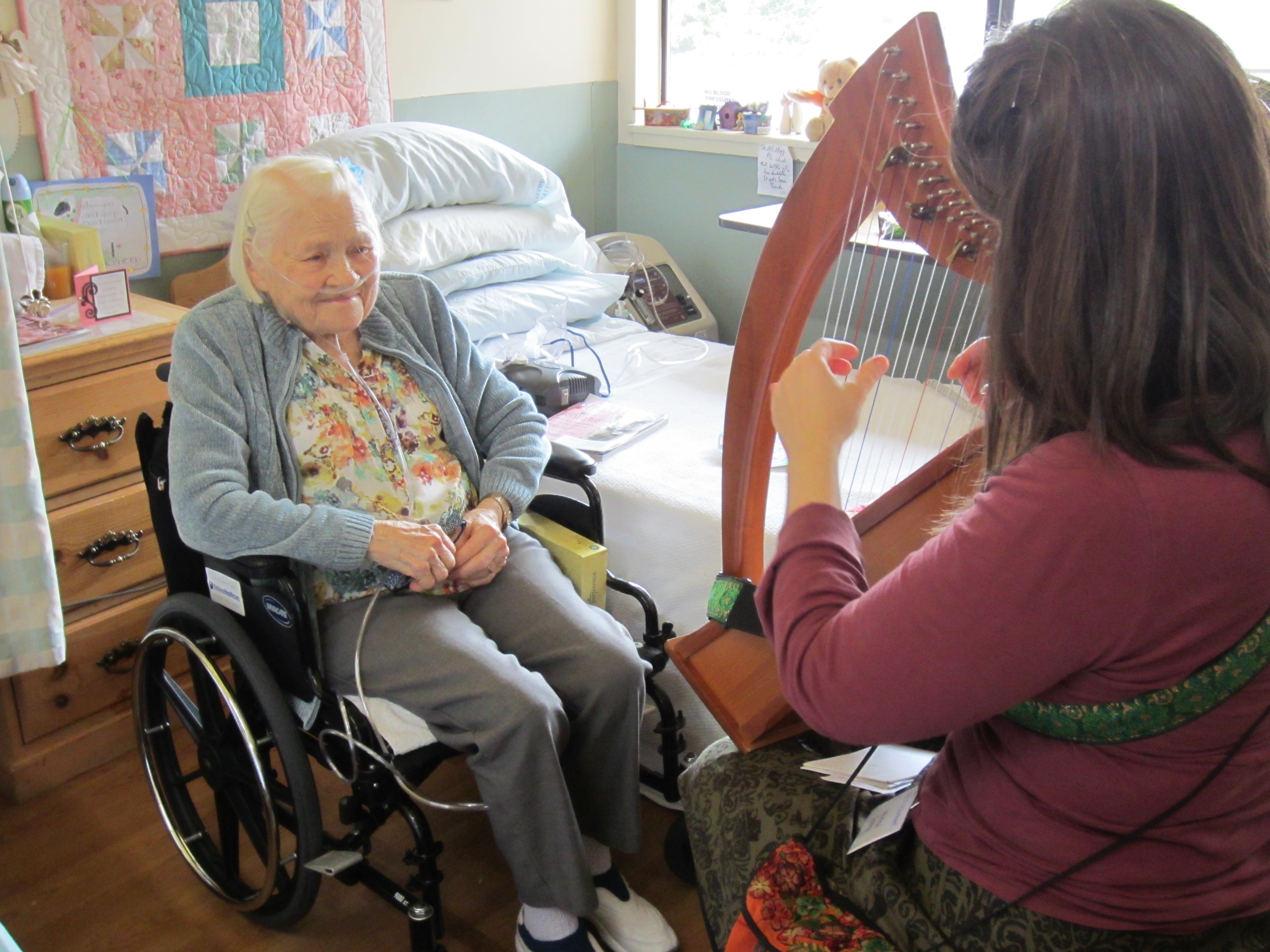
Often, when music is a part of a reverent ceremony, it is a service, rather than entertainment. For instance, when I worked for Providence Hospice as a complementary therapist, I played harp for clients whose life might be on the threshold of death at any minute. There are certain styles and sounds that are most effective at this time. Sometimes my client didn’t have any loved ones present, so the gift of music meant all the more to them.
Harp is an instrument synonymous with peace and love. Harp also soothes and heals, alleviating emotional grief, physical distress, anxiety, and exhaustion. As a harpist, I enjoy offering the sounds of calming harp for funeral music. It gives a positive impact for clients who have lost a loved one. I’ve studied the musical styles that work well in the situation of death. As a Certified Clinical Musician, I have studied the musical styles and songs that work well in the situation of death, such as ambient music. I can also play music that fits your family’s individual requests.
I have written compositions for the intention of creating peace of mind and healing. This relaxing style of music, by nature, helps to alleviate grief, stress, and other emotions associated with coping with death. Also, I have arranged a collection of Hildegard von Bingen’s songs, who was a Medieval plant medicine healer, spiritual leader, artist, musician, and composer.
I am always glad to accommodate requests of the family as best as I can within the time frame of the event. For a traditional church memorial, I may be asked to play hymns, like “Into the Garden,” or “Amazing Grace,” as well as accompany a vocalist. For a modern request, I have played songs by Sting and Michael Jackson at a memorial, because those songs were favorites of the deceased. Cultural folk songs might also be another request if the person was an immigrant or felt close to their ethnic heritage.
Outdoor Funeral Music
Another way to that calming harp for funeral music gives a positive impact is outdoors. Sometimes, it is best to play non-familiar songs for the sake of a family’s grief, particularly if the cause of death was tragic. In this case, songs that serve more as background music are better, because they conjure up less of an emotional reaction at a time that might already be too difficult for loved ones to bear. When this is the situation, I play ambient non-familiar music to be as soothing as possible, as I would in a hospital or hospice – a skill I learned as Certified Therapeutic Musician.
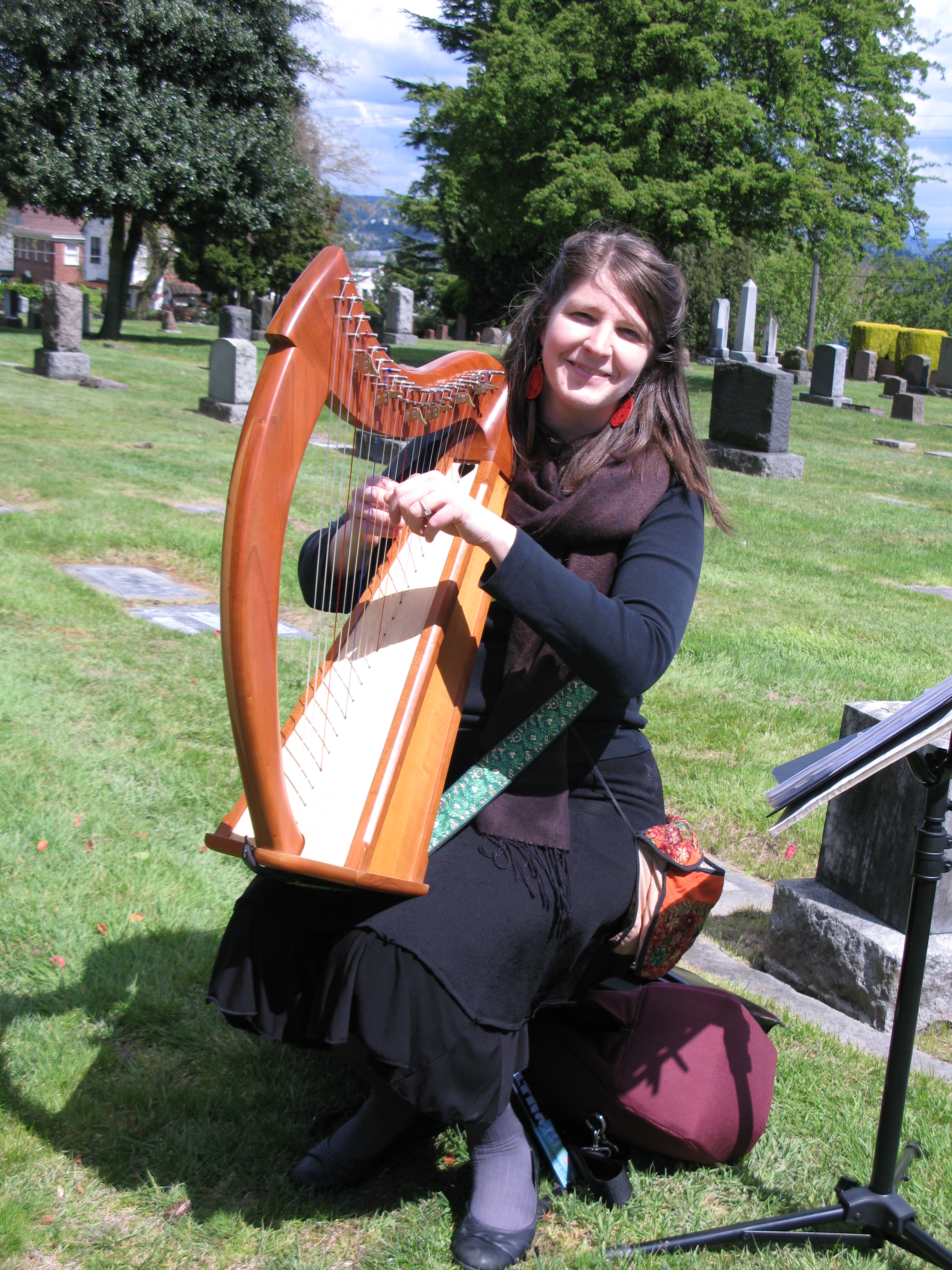
Gravesite burials are something I enjoy playing harp for when I am able to, and when weather allows. I have a very small harp that I use in these moments, but I can also bring my 34 string folk harp in the summer months. For many funerals, I have played harp at both the indoor memorial, and graveside location back-to-back on the same day, a scenario that works well at a traditional funeral home with attached cemetery. This photo was taken at Seattle’s iconic Lakeview Cemetery.
Plenty of people don’t want religious music at a funeral, and I have repertoire for them too. I am quite comfortable with traditional and non-traditional situations around death. I know how to seamlessly weave songs together if there is to be an event with little to no speaking.
I have been studying funeral music since 1995 when I played church organ at the funeral of a friend’s father, and I have been studying music much longer. Since 2012 I have studied and worked as a therapeutic musician, so that I can provide music as an in-person healing modality. I have seen countless times how calming harp music gives a positive impact to others.
Therapeutic Bedside Music
Places where I have experience and training to play harp music for death and dying:
Bedside vigil of someone actively passing on
Hospital and Hospice care
Group memorial ceremony (for funeral home or healthcare organization)
Individual memorial (in funeral home or columbarium)
Gravesite burial
Funeral home wake/visitation
Celebration of life
Combination of funeral home ceremony + gravesite relocation